
Payments
Can foreigners use Alipay in China?
Yes. Foreign visitors can link eligible international cards to Alipay for many QR payments, but should test early and keep backups.
Short answer
Yes. Overseas visitors can link eligible international bank cards to Alipay and use them for many ordinary merchant payments in China. Official guidance describes use across dining, transport, hotels, supermarkets, and other everyday scenarios.
Treat that as a strong primary setup, not a guarantee that every card, merchant, mini-program, or transfer-like flow will work. A linked card is only ready after you have completed a real payment and confirmed an independent fallback.
What the official guidance confirms
Chinese national and city guidance says foreign users can link supported international cards to Alipay. Shanghai's visitor guide also describes a direct international-card setup rather than requiring a prepaid account or a mainland Chinese phone number.
The practical sweet spot is a normal purchase from a merchant: you scan the merchant code or present your payment code, choose the linked card when needed, review the amount, and approve the charge.
Set it up before departure
Install Alipay, complete the identity steps shown for your account, and link the card you intend to use. Add a second eligible card from another issuer or network if you have one; two cards behind one phone are still easier to manage than one card with no recovery path.
Make sure you can receive any issuer approval through your banking app, SMS, or another method while abroad. A card can be linked successfully and still pause on the first unusual international charge.
Test Alipay before relying on it
Check card linking, a small first payment, issuer access, a second wallet or card, cash, and mobile data.
Run a small first-payment test
After arrival, use Alipay for one small, ordinary merchant purchase before you depend on it for a train connection, late-night taxi, hotel deposit, or larger meal. Confirm that the payment completes and appears correctly with your card issuer.
This separates three different states that travelers often confuse: the app accepted your account, the card linked, and a merchant payment actually cleared. Only the third state proves the working route you need.
Know what a successful test does not prove
One cleared shop payment does not prove that every mini-program, deposit, person-to-person flow, or unusually large purchase will use the same funding route. When a later payment fails, the cause may be the merchant flow, Alipay risk controls, your card issuer, or your connection rather than the whole wallet setup.
At the counter, check the amount and selected card, restore a stable data connection, and retry once. If it still fails, switch route instead of repeating the same charge: use the second card, another prepared wallet, a physical card where accepted, or RMB cash.
Build a payment fallback ladder
Use Alipay as the primary route only after the small test succeeds. Behind it, keep at least one independent option: a second wallet, another card, and some RMB cash in useful denominations. Official guidance preserves mobile payment, bank-card, and cash options for overseas visitors; the point is to keep more than one available.
Also protect the phone layer. Keep mobile data working, save your issuer's support route, carry a power bank, and avoid arriving at a payment screen with a dead battery or an account recovery prompt you cannot complete.
One-minute readiness check
Before relying on Alipay, confirm five things: identity steps are complete, the intended card is linked, issuer approval still works abroad, one small merchant payment has cleared, and a second payment route is immediately available.
If any one of those is missing, Alipay may still work—but your travel plan is not yet resilient. Use the free Payment Checker below to identify the missing layer before a time-sensitive purchase exposes it.
Open the illustrated guide
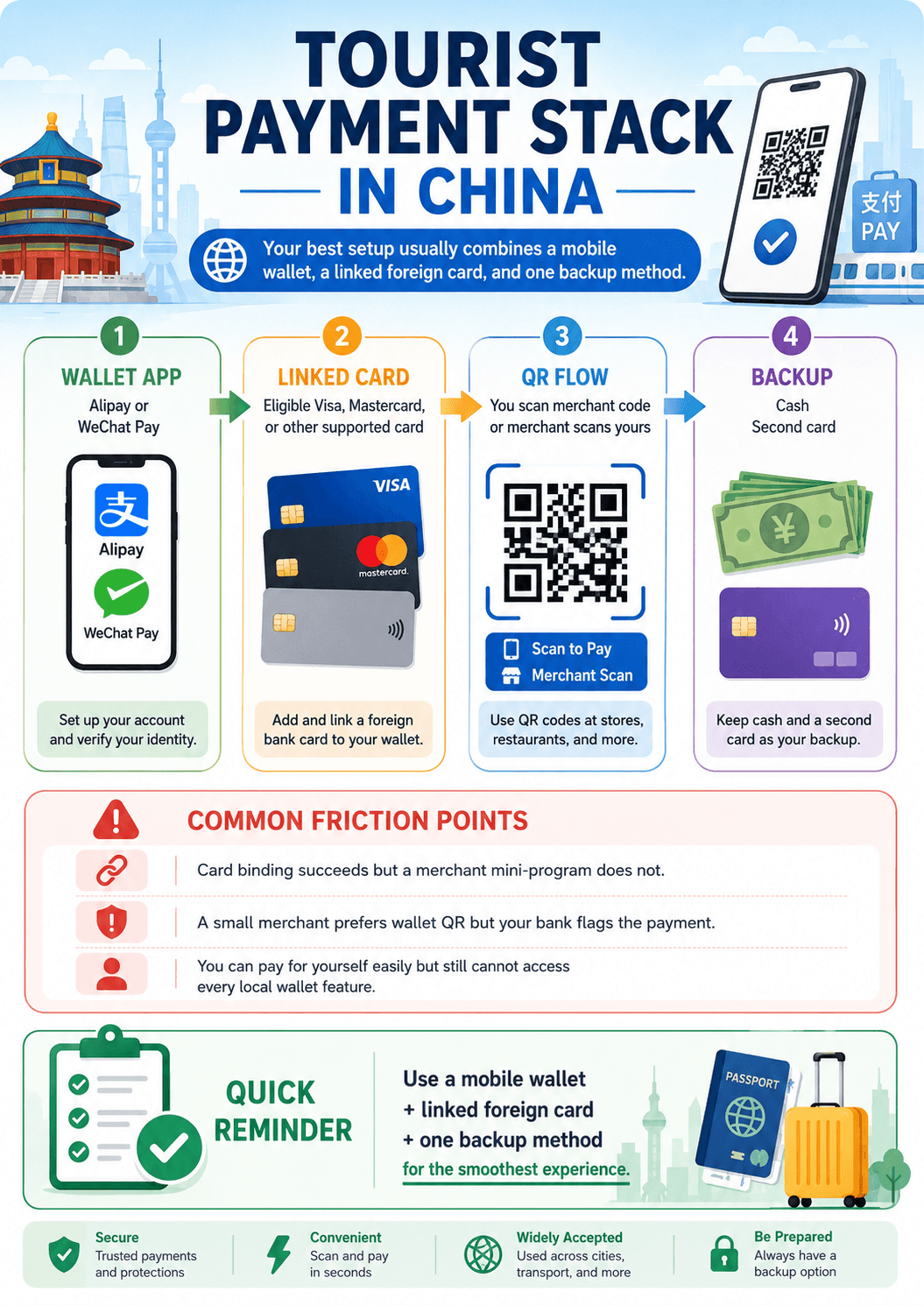
A successful Alipay trip depends on four layers working together: the app account, identity checks, card binding, and the merchant's QR flow. If any one layer fails, you need a backup method ready.
Keep this answer with your trip
Saved in this browser.
Practical answer, not legal advice.
Payment, telecom, app, and platform rules can change. Always verify current requirements directly with the relevant official authority or service provider before acting.
Sources
Test Alipay before relying on it
Check card linking, a small first payment, issuer access, a second wallet or card, cash, and mobile data.