
Travel Library
China Visa and Entry Guide for Foreigners (2026)
Visa-free entry, transit without visa, visa applications, passport validity, and arrival document checks — everything you need to enter China.
Use this library after the relevant checker or planner when you want the deeper source context, Q&A, and background explanations behind the short tool result.
Start with the checker, then use this library for source background.
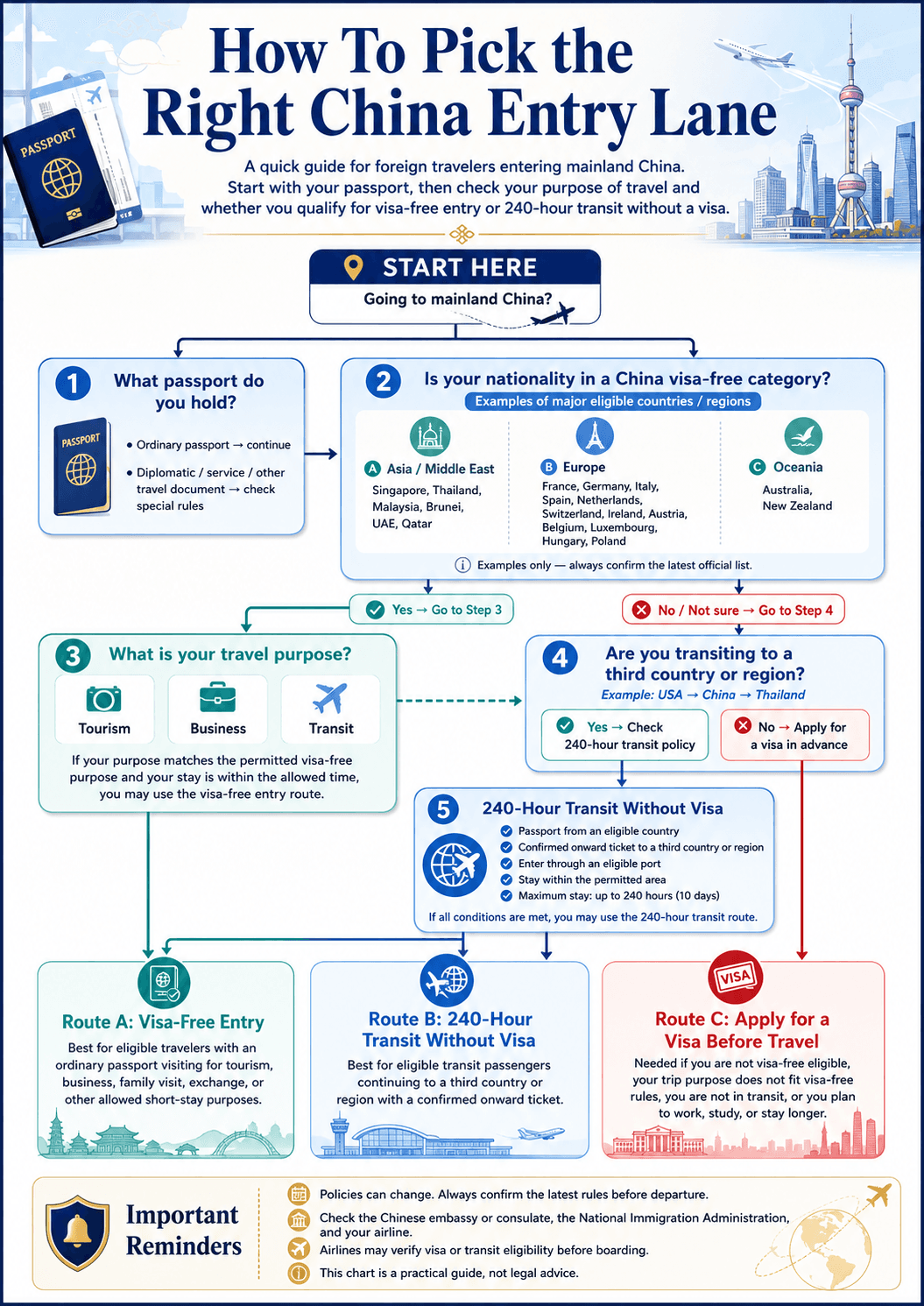
Entering China is not one process — it is three different processes depending on your nationality, travel purpose, and itinerary shape. Visa-free entry gives citizens of specific countries a short stay (15–30 days) without applying in advance. Transit without visa (TWOV) gives travelers up to 240 hours when passing through China to a third country, subject to strict route and area rules. Everyone else needs a visa applied for before departure at a Chinese embassy or authorized visa center.
The most common and most avoidable mistake is assuming that what worked on a previous trip — or what worked for a travel companion of different nationality — applies to your specific situation today. Visa-free eligibility changes. The 240-hour transit rule has port restrictions that catch even experienced travelers by surprise. Passport validity requirements differ by entry method. This section helps you identify the correct entry lane before booking, confirms what documents you need for each lane, explains what arrival-day checks look like, and answers the policy-sensitive questions about onward tickets, registration, and overstay rules that are not covered clearly in most general travel guides.
Featured questions
High-intent answers
Recommended tools
Practical tools for this topic
Recommended guides
Deeper reading for this topic
Choose Your Entry Route Before Booking
Start with your passport, purpose, travel dates and actual itinerary. Use the Entry Path Checker, then confirm the applicable rule with the responsible embassy or immigration authority.
- Unilateral exemption: eligible ordinary-passport holders can make qualifying short visits.
- Bilateral exemption: permitted stays and cumulative limits depend on the agreement.
- Transit without visa: eligibility depends on the immediate journey through mainland China to a different country or region.
- Ordinary visa: use the appropriate application route when no exemption covers your trip.
Border inspection makes the admission decision. Save the rule that applies to your travel dates.
Unilateral and Bilateral Visa Exemptions
The NIA unilateral list includes Canada, the UK and Australia. Eligible ordinary-passport holders may stay up to 30 days for the listed short-visit purposes. This does not authorize work or ordinary study.
Check the expiry against your arrival date. The Ministry of Foreign Affairs FAQ, checked September 26, 2026, lists December 31, 2026 for 48 countries, December 31, 2027 for Russia, and no stated expiry for Brunei. Older embassy copies may show a superseded Russian expiry.
The embassy FAQ allows eligible visitors to depart from any country or region and use ports open to foreign nationals, subject to applicable exceptions. A direct flight from your passport country is not a general requirement. The ordinary passport must cover the intended stay; temporary or emergency documents do not qualify under this waiver.
Bilateral agreements are separate. Do not apply one 30-day limit to every nationality in a mutual-exemption table. Check the agreement and any cumulative-stay condition.
Hainan and Other Regional Policies
Hainan has a separate 30-day exemption for eligible ordinary-passport holders, with travel confined to Hainan under that route. NIA's August 20, 2026 update lists 61 eligible countries. See the regional policy guide.
Before continuing to another mainland province, establish the entry basis covering that journey. Other regional or group arrangements have their own rules.
240-Hour Transit Without Visa
NIA's current transit policy, updated August 20, 2026, covers 57 nationalities, 65 entry ports and permitted areas in 24 provincial-level regions.
Prepare an eligible ordinary passport, a confirmed onward ticket with date and seat to a different country or region, and a route inside the permitted areas. Check passport validity and the onward destination's entry requirements too.
Country or region A → mainland China → B must have different A and B. Hong Kong, Macao and Taiwan can be onward regions. Returning to the same immediate origin does not qualify simply because you use different airports.
Cross-province visits are allowed within the designated areas. Consult the current port-and-area table for every stop; do not assume a city-only restriction for Chengdu or Xi'an, or unrestricted travel nationwide.
See the 240-hour answer for document and timing details. Recheck after any flight, port or overnight-stop change.
Applying for a Visa
Use the instructions of the embassy or visa center responsible for your application. Evidence, fees, appointments and processing times can differ by jurisdiction.
Read the visa's entry validity, number of entries and duration of each stay separately. Work or study may also require post-arrival residence formalities. The visa category alone does not establish your stay length.
See passport validity and port visas. Do not plan on obtaining an ordinary tourist visa after landing.
Arrival Documents
Keep your passport, entry basis, accommodation address and relevant onward booking together. Save copies offline and keep the original document accessible. Explain your actual purpose accurately.
NIA provides an official online arrival-card service, with on-arrival alternatives. Use the official announcement and channels, avoid paid lookalike services and follow your arrival port's instructions.
Related Questions
All Visa & Entry questions
Sorted by most recently reviewed