
Travel Library
China Travel Basics — First-Time Visitor Guide (2026)
Visa checks, entry documents, safety, packing, SIM cards, and arrival-day preparation for first-time visitors to China.
Use this library after the relevant checker or planner when you want the deeper source context, Q&A, and background explanations behind the short tool result.
Create a profile first, then use this library for background reading.
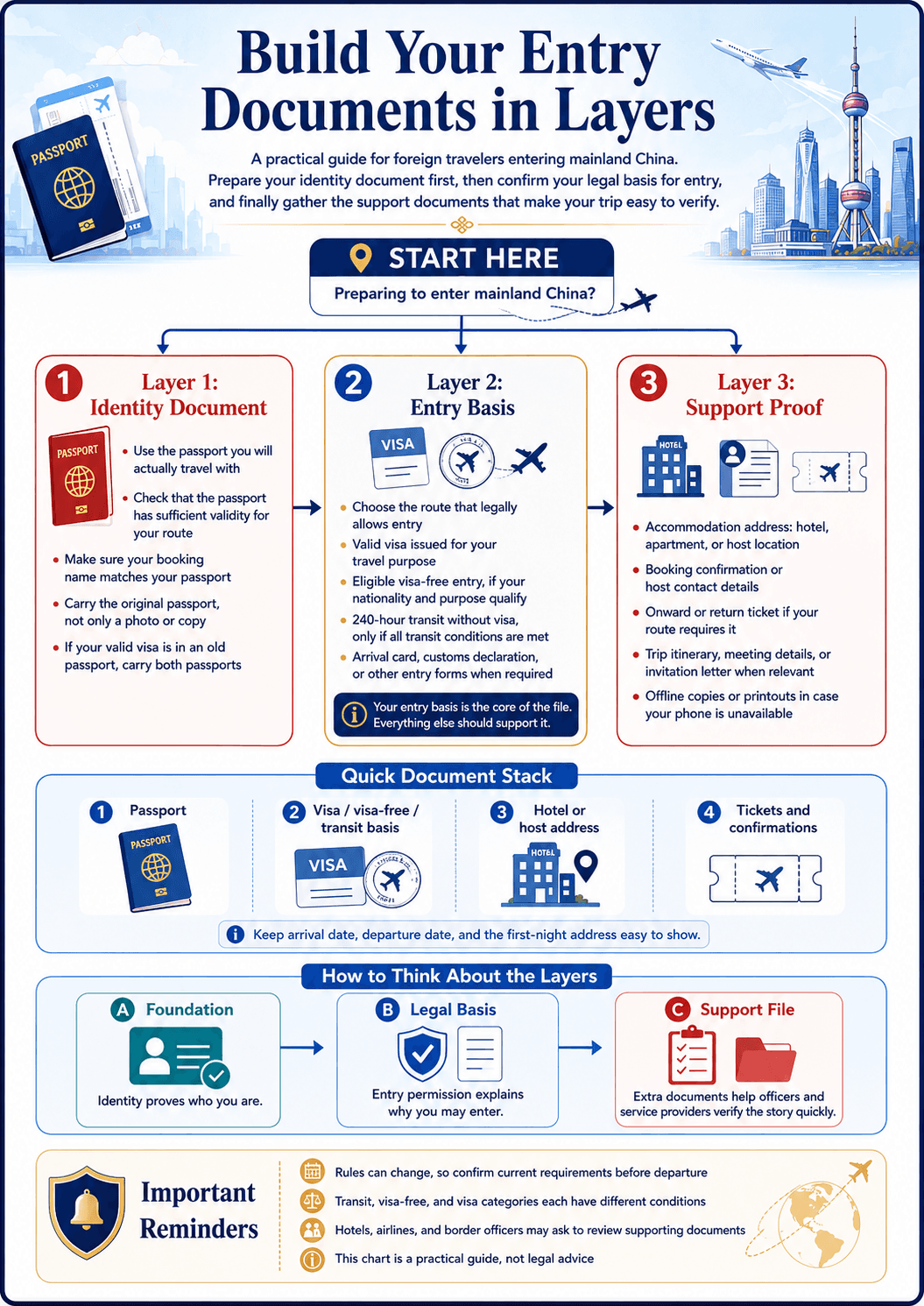
First-time visitors to China typically over-prepare for the wrong things and under-prepare for the right ones. The common pattern is spending time worrying about language barriers and cultural etiquette while arriving without a working mobile payment setup, a clear entry document plan, or a connectivity solution that covers the apps they depend on at home.
The three areas that actually determine whether the first day goes smoothly are entry readiness (do you have the right documents for your specific nationality and entry method?), digital setup (payment, connectivity, navigation, and translation — all tested before you land), and an arrival-day plan from the airport to your accommodation. Everything else is recoverable. These three are not. This section covers each pre-departure decision in order of urgency: visa and entry lane confirmation, SIM card or eSIM selection, packing the items most visitors forget, and an arrival-day checklist that prevents the most common first-hour problems for visitors to China.
Featured questions
High-intent answers
Recommended tools
Practical tools for this topic
China Travel Checklist
A free China travel checklist for entry documents, Alipay, mobile data, hotel check-in and arrival. Tick items on your phone or download a printable kit.
ToolPacking List for China
A focused China packing list for phone power, documents, payments, medication, weather, walking days, and arrival-day backups.
ToolApps You Need in China
Filter essential China apps by task: payments, maps, translation, ride-hailing, messaging, booking, and pre-arrival setup priority.
Recommended guides
Deeper reading for this topic
Start Here — What First-Time Visitors Get Right and Wrong
First-time China visitors usually over-prepare for the wrong things and under-prepare for the right ones. The common pattern: spend weeks worrying about language barriers and cultural etiquette, but arrive without a working mobile payment setup or a clear entry document plan.
The three things that actually matter before arrival
- Entry readiness — Do you have the right documents for your specific entry method?
- Digital setup — Payment, connectivity, navigation, translation — all ready before you land.
- Arrival plan — From the airport to accommodation, step by step.
This guide covers all three. The individual question pages linked throughout cover each topic in depth.
Visa and Entry Documents
Before booking anything, confirm your entry lane. This is the single most important pre-travel check.
The three entry lanes
- Visa-free entry — Check if your nationality qualifies
- Transit without visa — Check if your route qualifies
- Visa application — Apply at Chinese embassy if neither applies
Essential documents checklist
- [ ] Passport meeting the validity rule for your entry route; see the entry guide
- [ ] Visa or visa-free proof (printed)
- [ ] Return or onward ticket (screenshot or print)
- [ ] First-night hotel confirmation (with address in Chinese)
- [ ] Travel insurance (recommended, not mandatory)
- [ ] Passport photos (2, for backup)
Document rule: Paper backups matter. Do not rely solely on phone screenshots for your passport, visa, and tickets.
Getting a SIM Card
Having working internet from the moment you arrive transforms the first day.
Options
- Travel eSIM — Check device compatibility, carrier lock, activation timing and coverage before purchase.
- Local SIM — Bring your passport and confirm the counter, opening hours, plan and number requirements.
- Roaming — Compare your carrier's actual allowance, price and SMS terms with other options.
What to choose
| Scenario | Best option | |---|---| | Short trip (under 1 week) | Travel eSIM or roaming | | Medium trip (1–3 weeks) | Travel eSIM or airport SIM | | Long trip (3+ weeks) | Airport SIM or local store | | Need a China phone number | Airport or local store SIM |
Keep access to your verification number. Alipay can use an overseas number. A data-only eSIM does not replace SMS access to your home number. See Shanghai’s payment setup guide.
Safety and Health
Prepare for your actual itinerary, health and current conditions. Read your government’s travel advisory and keep insurance and emergency contacts available offline.
What to watch for
- Scams — Overcharging at tourist sites, fake ticket sellers, tea ceremony scams
- Pickpocketing — Busy areas, markets, and transport hubs
- Traffic — Jaywalking is common but dangerous; cross at designated crossings
- Food safety — Stick to busy restaurants; avoid street food that has been sitting out
- Air quality — Check AQI in your destination; pack a mask if traveling in winter or to industrial cities
Health preparation
- Check CDC’s China traveler guidance with a travel clinician. Vaccine recommendations and entry requirements differ; yellow-fever documentation can depend on your origin and transit.
- Check legality, quantity limits and documentation for your specific medicines before packing; keep original packaging and prescriptions. See CDC’s medicine-travel guidance.
- Do not assume the same medicine, formulation or prescription will be available locally. Plan essential supplies within the permitted import limits.
- Tap water is not drinkable — use bottled water
- Travel insurance with medical coverage is strongly recommended
Emergency numbers
- Police: 110
- Ambulance: 120
- Fire: 119
- Shanghai municipal service assistance (non-emergency): 12345
Save these numbers and your location in Chinese. Language support varies. See Shanghai’s hotline guide; 12345 is not a substitute for emergency dispatch.
Packing Basics
Essential items
- Passport and visa (and copies)
- Two payment cards from different networks
- RMB cash suited to your transfer, meals and emergency needs
- Charging cables and a power bank that meets your airline’s current battery rules
- VPN already set up (if needed)
- Travel adapter matched to your sockets and devices; check voltage compatibility
- Reusable water bottle
- Medications and basic first aid
Items to download before departure
- WeChat, Alipay, DiDi, Amap/Baidu Maps
- Offline translation language packs
- Offline map of your destination cities
- VPN app and config files
- Copies of passport, visa, travel insurance
Your phone is your wallet, your map, and your translator. Arriving with a fully charged phone, a power bank, and all essential apps installed changes everything about the first day.
Arrival Day Plan
On arrival at the airport, do these in order:
- Follow arrival signs — If you need airport Wi-Fi, use the official connection process; data-only eSIMs cannot receive ordinary SMS
- Pass through immigration — Have passport, arrival card, and return ticket ready
- Collect luggage — Follow signs to baggage claim
- Exit customs — Green channel if nothing to declare
- Get cash if needed — Compare the ATM or authorized exchange counter’s fees and rates
- Connect to mobile data — Activate eSIM, insert local SIM, or confirm roaming is working
- Test your payment — Buy a drink or snack at airport convenience store to test Alipay/WeChat Pay
- Go to accommodation — Use your planned metro, airport rail, licensed taxi or booked ride, then confirm accommodation registration
Test your payment at the airport. Do not wait until you are at a small shop or taxi stand to discover your wallet setup has a problem.
Related Questions
All Travel Basics questions
Sorted by most recently reviewed