WaytoEastYour Guide to Traveling in China

Guide

How to Pay in China as a Foreigner (2026 Complete Guide)

Alipay, WeChat Pay, foreign cards, cash, and ATM withdrawals — explained for visitors without a Chinese bank account.

How to Pay in China as a Foreigner (2026 Complete Guide)

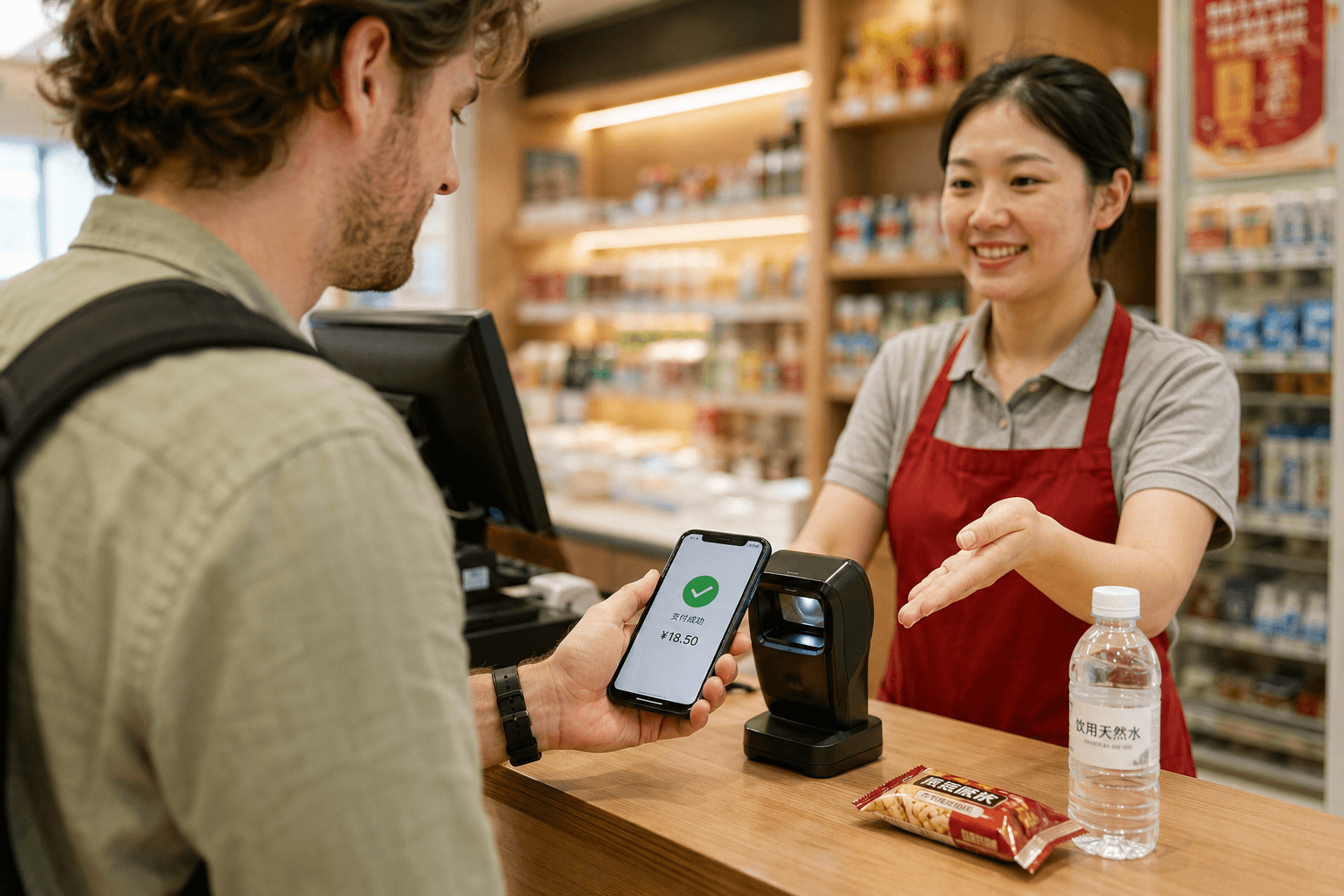
China runs on QR-code payments rather than card terminals, and most foreign visitors discover this at the first street market or metro station. The practical setup is three layers: a mobile wallet (Alipay or WeChat Pay linked to a foreign card) as your primary tool, a physical bank card as backup for hotels and larger stores, and a small amount of RMB cash for the edge cases where neither option works.

Since 2023, both Alipay and WeChat Pay allow visitors to link overseas credit or debit cards directly without needing a Chinese bank account. Most visitors complete wallet setup in under fifteen minutes before departure. The real risk is not the initial setup — it is arriving with only one payment method and meeting a merchant that only accepts the other. This section covers each payment layer in detail: where each one works, where it fails, how to set up both wallets before you leave home, and what to do when a payment does not go through.

Start Here — What Changes and What Does Not

China is not a cashless society — it is a QR-payment society. The difference matters because many travelers arrive expecting either "just use my Visa everywhere" or "cash is dead." Neither is accurate.

The practical setup for a short-term visitor is three layers deep:

  1. Mobile wallet (Alipay or WeChat Pay with a linked foreign card) — your primary tool
  2. Physical bank card (Visa, Mastercard, UnionPay from home) — backup for larger purchases
  3. Cash (RMB) — fallback for edge cases

Each layer has limits. The key is knowing where each one works and having a plan when it does not.

What has changed: Since 2023, both Alipay and WeChat Pay have significantly loosened foreign-card linking. Most visitors with a passport and an eligible overseas card can set up a wallet before arrival. The old "you need a Chinese bank account" advice no longer applies.

What has not changed: QR codes remain the dominant payment flow. Small merchants, market stalls, and informal sellers still operate on payment channels that may not accept foreign-linked wallets. Cash and card acceptance also remain inconsistent outside international-facing venues.

Alipay for Foreigners — The Primary Wallet

Alipay is the most foreigner-friendly option for visitors because its international version was specifically designed for this use case.

What you need

  • Passport
  • Eligible overseas credit or debit card (Visa, Mastercard, JCB, or UnionPay)
  • An email address or phone number (foreign number works)

Setup process

  1. Download the app (TourPass / Alipay international version)
  2. Register with your email or foreign phone number
  3. Add your passport details for identity verification
  4. Link an overseas card
  5. Test with a small payment

Most travelers complete setup in 10–15 minutes.

Where it works best

  • Supermarkets, convenience stores, chain restaurants
  • Hotel payments and deposits
  • Ride-hailing payments (Alipay-integrated DiDi)
  • Metro QR entry (in most major cities)
  • Online purchases (hotel booking, train tickets on 12306)
  • QR code payments at formal merchant checkouts

Where it may fail

  • Personal collection codes used by market vendors
  • Some mini-programs that require a Chinese ID
  • Merchant accounts that only support domestic payment methods
  • Very small or informal sellers

Card linking tips

One card is not enough. If your primary card fails, a second card from a different network (e.g., Visa + Mastercard or Mastercard + UnionPay) significantly increases your reliability.

Notify your bank. Some international banks still flag China transactions as unusual, even when Alipay processes them.

WeChat Pay for Tourists

WeChat Pay (Weixin Pay) is the other dominant wallet in China, tightly integrated with the WeChat messaging and mini-program ecosystem.

How it differs from Alipay

  • WeChat Pay is within the WeChat app — you need WeChat first
  • Foreign card linking is available but slightly less tested than Alipay for some card types
  • WeChat mini-programs (hotel booking, food delivery, ride-hailing) often expect WeChat Pay as default
  • Some merchants accept Alipay but not WeChat Pay, and vice versa

Setup

  1. Install WeChat and register with your foreign number
  2. Add a payment method (WeChat Pay menu → Cards)
  3. Verify identity with passport when prompted
  4. Link eligible overseas card

Recommendation: Set up both Alipay and WeChat Pay before your trip. Having two wallets dramatically reduces the chance of being stuck at a merchant that only accepts one. Two wallets, two cards per wallet, and some cash.

Foreign Cards — When They Work and When They Do Not

Physical cards are most useful in specific settings and less useful in everyday street-level transactions.

Where cards work

  • International hotel chains and large domestic hotels
  • Higher-end restaurants and department stores
  • Supermarkets and shopping malls
  • Airport shops and duty-free
  • Some larger train station ticket counters
  • Car rental agencies

Where cards do not work

  • Street food stalls
  • Small restaurants and local eateries
  • Market vendors and pop-up shops
  • Taxis (most do not have card terminals)
  • Metro ticket machines (many expect QR or mobile)
  • Small convenience stores

Card network acceptance

| Card network | Acceptance | |---|---| | Visa | International hotels, malls, some restaurants | | Mastercard | Similar to Visa, slightly broader | | UnionPay (overseas) | Best acceptance, works on domestic network | | JCB | Large hotels and tourist venues | | American Express | Limited, mainly high-end hotels | | Diners Club | Very limited |

The most reliable strategy: Link your card to a mobile wallet rather than presenting it directly. The wallet handles the conversion, and acceptance is significantly broader.

Cash — Still a Backup, Not a Primary Plan

Cash acceptance in China has declined dramatically over the past decade, but removing it entirely from your strategy is a mistake.

Why carry cash

  • Some small merchants and market stalls only accept cash
  • Backup when both mobile wallets fail or network is unavailable
  • Taxis that do not have QR or card terminals
  • Rural or less developed areas
  • Emergency situations (lost phone, dead battery)

How much to carry

  • Start with 500–1000 RMB (approximately $70–140)
  • Refill as needed from ATMs
  • Do not carry large amounts — cash is for edge cases

Where to get cash

  • ATMs at airports (arrival halls have multiple banks)
  • Bank of China, ICBC, and other major bank ATMs in cities
  • Hotel concierge (limited, for emergencies)

ATM tips

  • Look for ATMs that display Visa/Mastercard/UnionPay logos
  • Withdrawal limits vary by bank (typically 2000–5000 RMB per transaction)
  • Your home bank may charge foreign transaction and ATM fees
  • Notify your bank before departure to avoid fraud blocks

Warning: Do not exchange foreign currency at hotels or small exchange counters — rates are poor. Use ATMs for better rates, or exchange at airports for convenience with a reasonable rate.

Putting It Together — A Payment Strategy

Before departure

  • [ ] Install Alipay and WeChat Pay
  • [ ] Register and verify identity with passport
  • [ ] Link two different cards to each wallet (if possible)
  • [ ] Notify your banks about China travel
  • [ ] Download offline copies of payment setup screenshots
  • [ ] Withdraw some RMB from your local bank (optional, can do at arrival)

Arrival day

  • [ ] Test both wallets at airport convenience store or café
  • [ ] Withdraw 500–1000 RMB from ATM
  • [ ] Confirm your primary card works at a hotel checkout or mall
  • [ ] Keep your physical cards accessible (not buried in luggage)

Daily workflow

  1. Use Alipay as default for QR payments
  2. Use WeChat Pay as mobile backup
  3. Use physical card for hotels, larger stores, car rental
  4. Use cash for market stalls, taxis, small vendors, emergencies

When something fails

  • Do not retry more than twice — it will not suddenly work
  • Switch to your backup wallet
  • If both wallets fail, try physical card
  • If card fails, use cash
  • If none works, ask the merchant what does work

The bottom line: Two wallets, two cards, some cash. That is the minimum reliable setup for China. Anything less and you are gambling on the specific merchant.

All Payments questions

Sorted by most recently reviewed

Can foreigners use Alipay in China?Yes. Foreign visitors can usually register Alipay, link eligible international cards, and use the wallet for everyday QR-code payments in mainland China. The practical warning is that merchant acceptance, card-risk checks, and access to deeper local wallet features can still vary, so you should test it early and carry backups.Updated 2026-05-04How do I use Alipay in China as a tourist?Set it up before arrival, link an eligible international card, and learn the two core QR-code flows before you need them in public. For most tourists, Alipay works best when it is treated as a travel system with backups, not as a magic app that fixes every payment situation automatically.Updated 2026-05-04Can foreigners use WeChat Pay?Yes. Many foreign visitors can register WeChat, link eligible international cards, and use WeChat Pay for ordinary merchant QR-code payments in mainland China. The important limitation is that successful setup does not guarantee every merchant, mini-program, or account feature will behave like a local resident account.Updated 2026-05-04Can I use credit cards in China?Yes, but not as your main everyday payment method. International credit cards are most reliable at hotels, airports, premium retail, and some foreigner-facing venues. In many ordinary local transactions, linking a foreign card to Alipay or WeChat Pay is more useful than presenting the physical card directly.Updated 2026-05-04Is cash still accepted in China?Yes. Cash is still legal tender and remains a useful backup for travelers in China, but it is no longer the smoothest main payment method in many day-to-day situations. Carry it as a fallback layer, not as the only plan you expect to use comfortably everywhere.Updated 2026-05-04Will my international card trigger payment risk controls in China?It can. Foreign-card wallet payments in China are normal enough to be useful, but first-time setup, identity mismatches, repeated failed attempts, unusual merchants, or larger spending can all trigger bank, wallet, or merchant-side controls. Bring a backup card and expect the occasional decline even when the overall setup is valid.Updated 2026-05-04Can I withdraw renminbi from ATMs in China?Yes, usually. Many bank ATMs in China let foreign visitors withdraw RMB with cards that match the machine's supported network logos, but the real-world result still depends on your card issuer, your PIN format, your daily limits, and the particular bank or machine you try.Updated 2026-05-04Can I pay for family or friends with my China wallet?Yes for many merchant bills, often no for person-to-person transfers. If you mean paying a restaurant, taxi, hotel, or attraction checkout for your whole group, one foreign-card-linked wallet can often do that. If you mean sending money directly to a friend, topping up their wallet, or using red packets or transfer features, foreign-card accounts are much more restricted.Updated 2026-05-04Will Small Shops in China Accept Foreign-Card Mobile Payments?Yes — **foreign-card-linked mobile payments are much more usable in China than they were a few years ago**.