
Travel Basics
Do I need a visa for China?
Maybe. Your visa need depends on nationality, passport type, purpose, route, stay length, and whether a visa-free or 240-hour transit lane applies.
Short answer
You should stop asking the question as if China had one single entry rule. The current system is really a set of separate lanes: nationality-based 30-day visa-free entry for listed ordinary-passport holders, 240-hour transit without visa for eligible transit travelers, and regular visas for trips that fall outside those lanes.
That matters because a traveler can be fully eligible for one lane and fully ineligible for another. Someone who qualifies for 30-day visa-free tourism may still fail the 240-hour transit test, while someone on a genuine third-country transit route may not need a regular tourist visa even if their nationality is not on the 30-day list.
Lane one: nationality-based visa-free entry
The first official check is your passport nationality and passport type. Embassy guidance separates ordinary-passport eligibility from other travel-document categories, and the visa-free FAQ also limits the permitted purposes to specific short-term activities such as tourism, business, visits, exchange, and transit.
This is the lane that most leisure travelers hope to use, but it is also the lane people oversimplify. Being on a country list is not enough by itself if you are traveling for work, study, journalism, long stays, or some other purpose that sits outside the allowed scope.
Lane two: 240-hour transit without visa
Transit without visa is not a backup for every traveler who dislikes visa paperwork. It only works if your nationality is eligible, you enter through a participating port, you have valid onward arrangements to a third country or region, and your stay remains inside the permitted area and time window.
The route logic is where many trips fail. Country or region A to mainland China to country or region B can work. Country or region A to mainland China and then back to A is the wrong shape for this policy, even if the stop in China is short.
Add this to your trip plan
Use the free Planner to keep this trip detail in the current browser.
Lane three: regular visa
If your nationality is not on the current visa-free list, your route does not qualify for transit without visa, or your trip purpose falls outside the allowed short-stay categories, you should assume you need a regular visa. That includes many work, study, internship, media, and longer-duration stays.
This is where travelers lose money by forcing the wrong theory onto the trip. If you need a regular visa, the efficient move is to accept that early and prepare the right application instead of trying to rescue the plan at check-in.
How to decide before you book
Use a fixed order. First, identify the passport you will actually present at boarding and arrival. Second, confirm whether that nationality appears on the current visa-free list or the 240-hour transit eligibility framework. Third, match the purpose of travel. Fourth, test the route itself, especially onward-ticket and third-country logic.
If the answer still feels ambiguous after those four checks, treat that as a warning sign rather than a minor detail. Ask the embassy, visa center, or airline before buying non-refundable tickets, because airline document screening is often the first practical gatekeeper.
What travelers still get wrong
The most common mistake is collapsing several different policies into one sentence such as 'China is visa-free now.' That shortcut hides the exact details that actually decide eligibility: nationality, route, purpose, and stay length.
The second mistake is trusting a forum summary more than the rule that applies to the exact lane you want to use. Traveler reports are useful for spotting friction, but official policy pages should decide whether you qualify at all.
Open the illustrated guide
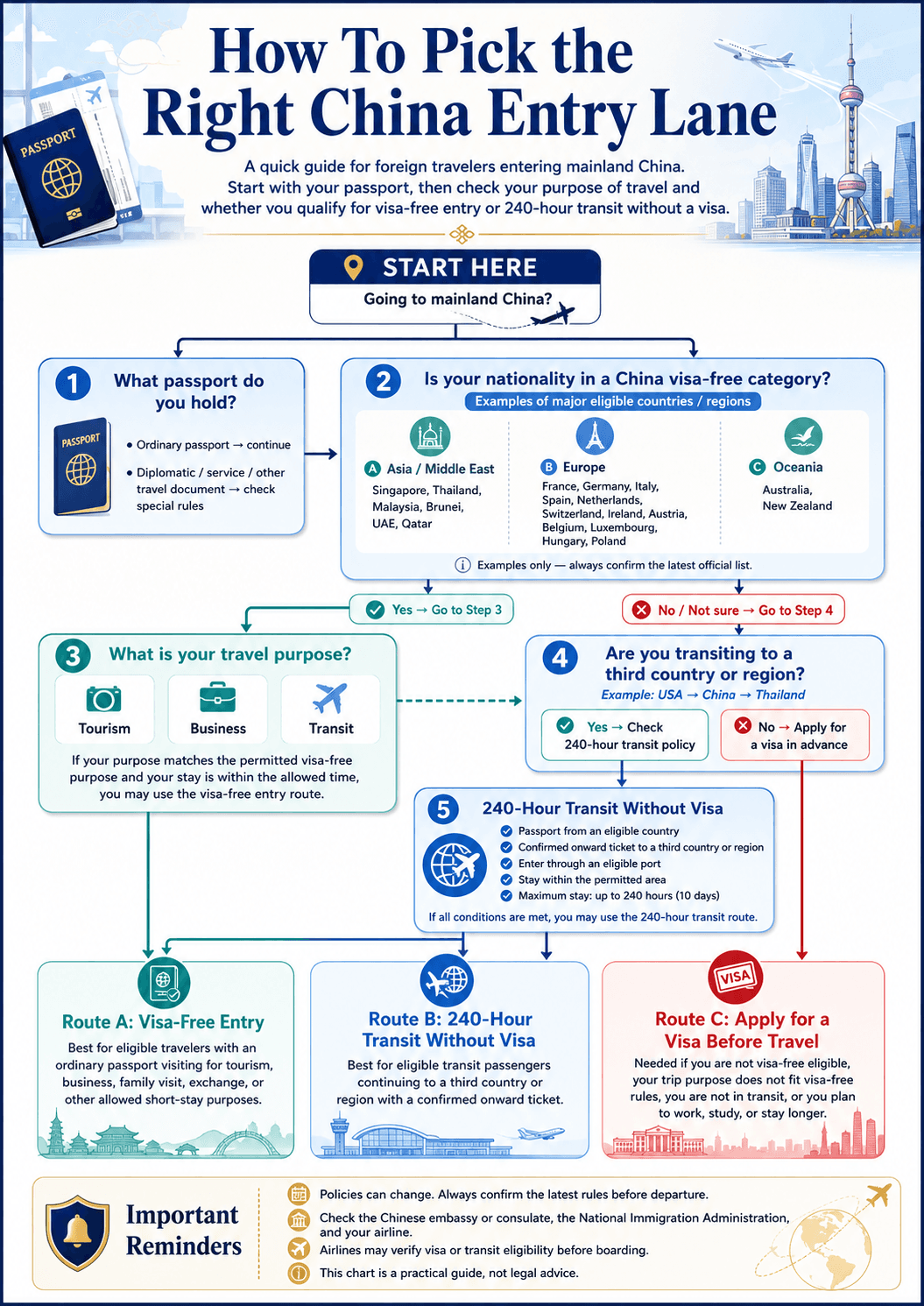
Most travelers only need to identify which of three lanes they are using: nationality-based visa-free entry, transit without visa, or a regular visa. Once you know the lane, the document list becomes much clearer.
Keep this answer with your trip
Saved in this browser.
Practical answer, not legal advice.
Payment, telecom, app, and platform rules can change. Verify policy-sensitive details with the provider or official source before making expensive plans.
Sources
Add this to your trip plan
Use the free Planner to keep this trip detail in the current browser.