
Travel Basics
What documents do I need to enter China?
Bring the passport you will use, the right visa or visa-free basis, hotel or host details, and onward-ticket proof if your route needs it.
Start with the identity document that drives the whole trip
The core document is the original passport you will actually use at boarding, arrival, hotels, and any later train or flight check. If you booked with one passport but turn up with another, the rest of your paperwork becomes much harder to defend even when the names look similar.
Do not treat passport copies, screenshots, or cloud-stored scans as substitutes for the original. They are useful backups, but they do not replace the physical document when an airline desk, border officer, station counter, or hotel front desk needs to match identity in real time.
Then match the document stack to your entry lane
Your next layer depends on how you are entering. If you need a regular visa, you need the visaed passport or other official authorization tied to that route. If you are using nationality-based visa-free entry, you need to be able to show that your passport nationality and trip purpose fit the current policy. If you are using 240-hour transit without visa, your onward ticket to a third country or region becomes part of the core package.
This is why one generic airport folder is rarely enough. The right question is not 'what do all travelers need' but 'what extra proof makes my exact route easy for the airline and border officer to understand.'
Add this to your trip plan
Use the free Planner to keep this trip detail in the current browser.
Support documents make the story credible
Keep your first-night hotel booking, full host address if staying with someone, and basic itinerary accessible offline. These are simple documents, but they answer the practical questions travelers get most often: where are you staying, how long are you staying, and what does the trip look like.
If your route relies on transit without visa or any other onward-travel condition, keep the confirmed outbound booking close to the passport. The best setup is one folder with the passport photo page scan, hotel confirmation, onward ticket, and any invitation or business support document relevant to the trip.
Arrival-card and declaration details can change
Arrival-card and declaration procedures are operational rather than theoretical, so they can change faster than traveler blog posts. Current official notices stress using the approved channels for online arrival-card or border-declaration workflows rather than third-party links or random search results.
That means you should check the latest official instructions shortly before departure, not only once at the planning stage. Even when the form itself is simple, the wrong website or an outdated assumption is a bad surprise to discover in the immigration queue.
How to carry the documents sensibly
Put the passport, first-night accommodation, and any onward-ticket proof in one offline-access folder on your phone, and also keep a second copy in email or cloud storage. That way you can still reach the essentials if airport Wi-Fi fails, your main phone app logs out, or a battery problem interrupts access.
The key is not to carry a giant archive. It is to carry the five or six documents that explain the trip cleanly. A smaller and better-curated folder is more useful than a messy dump of every PDF you have ever received.
What travelers still get wrong
A common mistake is bringing only the documents needed to prove legal eligibility and forgetting the documents that make the trip operationally easy to process. In reality, hotel details and onward proof often matter just as much as the headline visa rule.
The second mistake is assuming every airport or airline desk already understands the newest China policy update. Keep the official page you relied on available offline so you can show the rule if necessary.
Open the illustrated guide
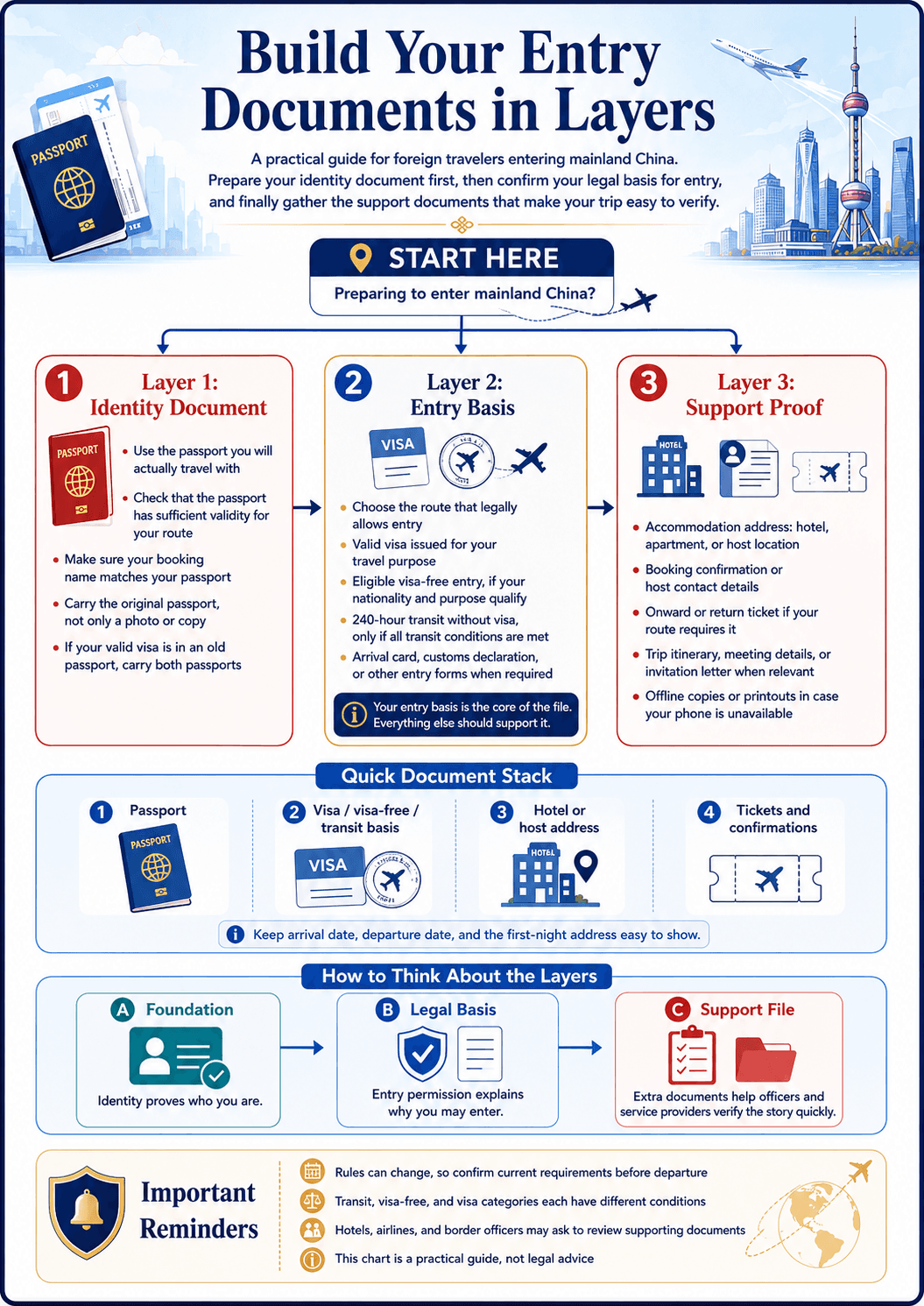
Think in layers: identity document, entry basis, and support documents. This is the easiest way to avoid bringing the right passport but the wrong proof for your specific route.
Keep this answer with your trip
Saved in this browser.
Practical answer, not legal advice.
Payment, telecom, app, and platform rules can change. Verify policy-sensitive details with the provider or official source before making expensive plans.
Sources
Add this to your trip plan
Use the free Planner to keep this trip detail in the current browser.