
Accommodation
Do all hotels in China accept foreigners?
Hotels should not reject foreign guests over registration paperwork. Confirm passport check-in, arrival time and registration before booking.
Short answer
Chinese authorities have told hotels not to refuse foreign guests because they cannot process the registration paperwork. The July 2024 accommodation measures also prohibit qualification restrictions imposed by local authorities or booking platforms and unlawful “no foreign guests” notices.
That does not confirm the arrangements for your particular booking. Before paying, ask the property to confirm passport check-in, your arrival time and how it will complete accommodation registration. Keep its written reply with the booking confirmation.
Hotel stays and private stays have different registration duties
Hotels are responsible for registering their foreign guests and submitting the information to local public security. Present the valid travel document used for your booking and confirm the front desk’s check-in requirements. The National Immigration Administration explains these responsibilities.
For a private apartment, family home or other non-hotel stay, you or your host must complete registration with local public security within 24 hours of arrival at the accommodation. Confirm the filing method for the actual address before arrival; do not assume that a booking platform completes it for you. See the private-stay registration guide.
Check your first-night setup
Review check-in details, your Chinese address, booking proof, and a backup stay.
What to confirm with the property
Ask about the process for your actual stay instead of assuming that a price category or hotel brand guarantees a smooth check-in. Describe the travel document you will present and ask whether staff will be available at your expected arrival time.
A useful message is: “I plan to arrive on [date] at [time] using a [country] passport. Please confirm the check-in requirements and accommodation registration process, and send your Chinese address and front-desk phone number.” If the answer is unclear, ask the booking platform to resolve it before committing to the stay.
How to prepare before you arrive
Check the cancellation deadline, payment conditions and late-arrival instructions for the room you select. Flexible cancellation can help you change plans, but do not assume that every booking includes it or that a dispute guarantees a refund.
Save the property’s Chinese name, full address, phone number, booking confirmation and written reply offline. Plan the route from your arrival airport or station and keep details for a nearby alternative, especially if you expect to arrive late.
What to do if a property refuses you
Ask which document or check-in step is missing and contact the booking platform for help. If you need a room that night and the issue cannot be resolved promptly, use your prepared alternative. For accommodation-registration questions, contact local public security or the NIA’s 12367 service hotline.
Keep the booking confirmation, the property’s written reply and any explanation of the refusal. Contact the booking platform to ask about available assistance and the cancellation or refund process. The outcome depends on the booking terms and circumstances.
Keep the booking and registration steps separate
An available room or successful payment does not show that check-in and accommodation registration are complete. Written confirmation helps you prepare, but it cannot guarantee how an individual arrival will go.
Use the free accommodation checker below to review your first-night details, Chinese address, booking proof and backup stay. It does not contact the property, confirm acceptance or complete registration for you.
Open the illustrated guide
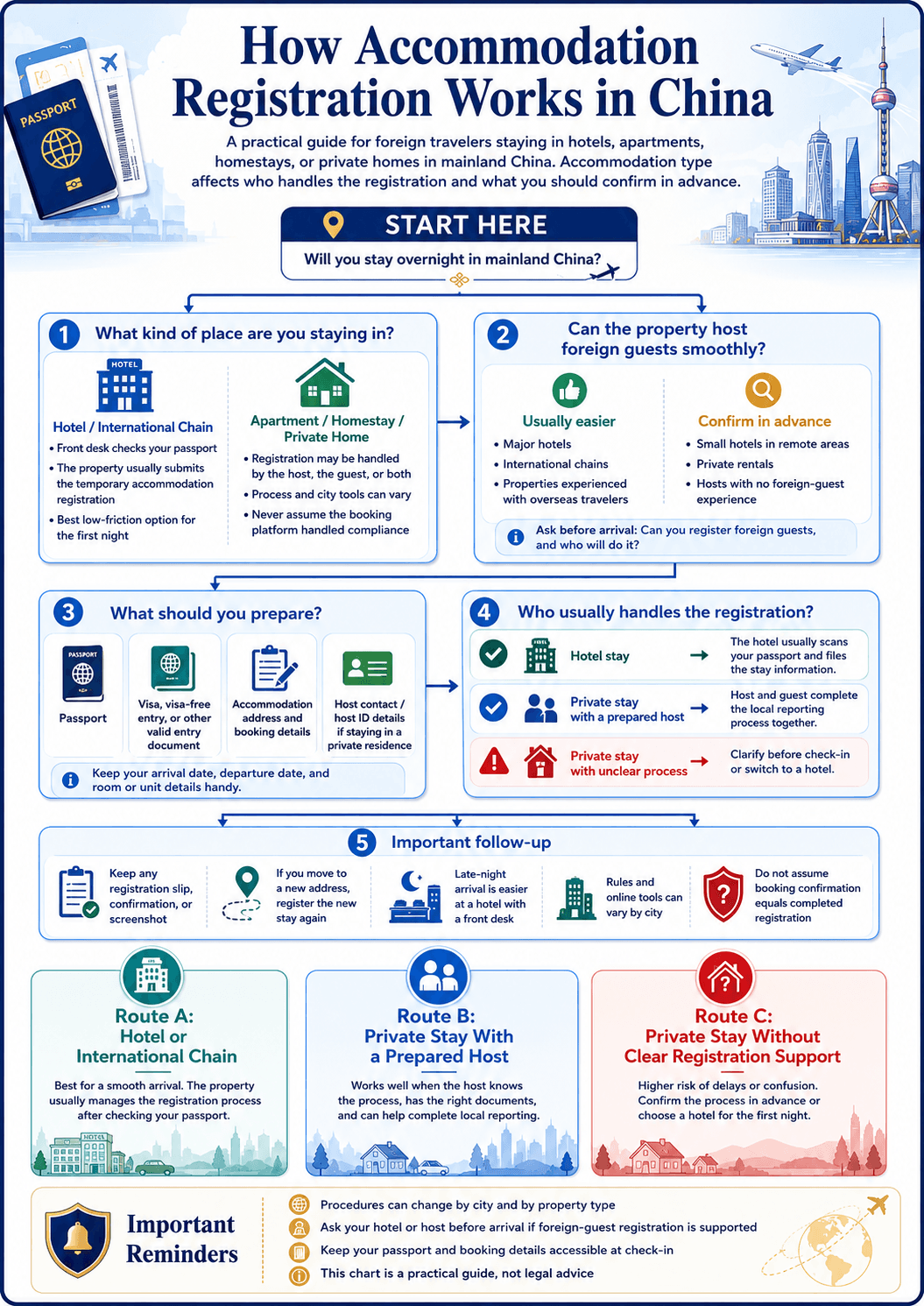
This diagram separates what the policy direction says from where traveler friction still shows up in practice. It is mainly about helping readers choose safer first-night accommodation, not about winning arguments at the desk.
Keep this answer with your trip
Saved in this browser.
Practical answer, not legal advice.
Payment, telecom, app, and platform rules can change. Always verify current requirements directly with the relevant official authority or service provider before acting.
Sources
Check your first-night setup
Review check-in details, your Chinese address, booking proof, and a backup stay.