
Accommodation
Do hotels register foreign guests in China?
Yes. Hotels register foreign guests with local public security when you check in; private stays usually need separate temporary registration.
Short answer
Yes. Hotel stays are the easy version of accommodation registration because the hotel should handle the reporting for you. This is exactly why hotels are still the safest choice for first-time visitors who do not want to deal with police-station paperwork after arrival.
The complication starts when the stay is not a hotel. Apartments, serviced residences, homestays, and private homes usually shift part of the burden to the host or the traveler.
What the official rule says
The NIA's March 2026 interpretation of Article 39 says hotels submit guests' registration information. For non-hotel stays, the visitor or host must register with local public security within 24 hours of arrival at the accommodation. Do not plan around a longer rural deadline quoted by older pages.
That is the core distinction to remember: hotel equals hotel staff process; private residence equals host-or-guest process.
What happens at a hotel in practice
In a normal hotel check-in, staff scan or copy the passport, take the visa or entry basis if needed, and transmit the registration electronically. You usually do not need to visit the police station yourself, and many travelers never see any additional paperwork beyond the front-desk check-in.
If the hotel seems confused, asks you to solve the registration entirely on your own, or says it cannot process foreign passports at all, that is a signal that the property may not be a good operational fit for international travelers.
Check your first-night setup
Review check-in details, your Chinese address, booking proof, and a backup stay.
When you should ask for proof
Most of the time you do not need a printed registration slip for everyday travel. But it is sensible to ask for confirmation or keep a screenshot if you are staying only one night, changing cities quickly, or dealing with a property that felt disorganized during check-in.
A registration record can become useful if another official process later asks where you stayed first or if a later host wants reassurance that the earlier segment was handled correctly.
What to prepare before arrival
Carry the passport you used for entry, know the exact booking name, and keep the hotel's Chinese address available on your phone. If you are staying in a non-hotel property later in the trip, ask the host in advance who will handle registration and how.
Do not wait until midnight check-in to learn that the host expects you to go to a police station yourself. This is a planning conversation, not an afterthought.
What travelers still get wrong
Travelers often assume that one successful hotel registration means every later property will be just as smooth. In reality, the weakest link is usually the non-hotel stay or the smaller property that handles foreign guests rarely.
The second mistake is thinking the registration rule is optional because no one asked immediately. It is a compliance task that is easy when you choose the right accommodation and annoying when you do not.
Open the illustrated guide
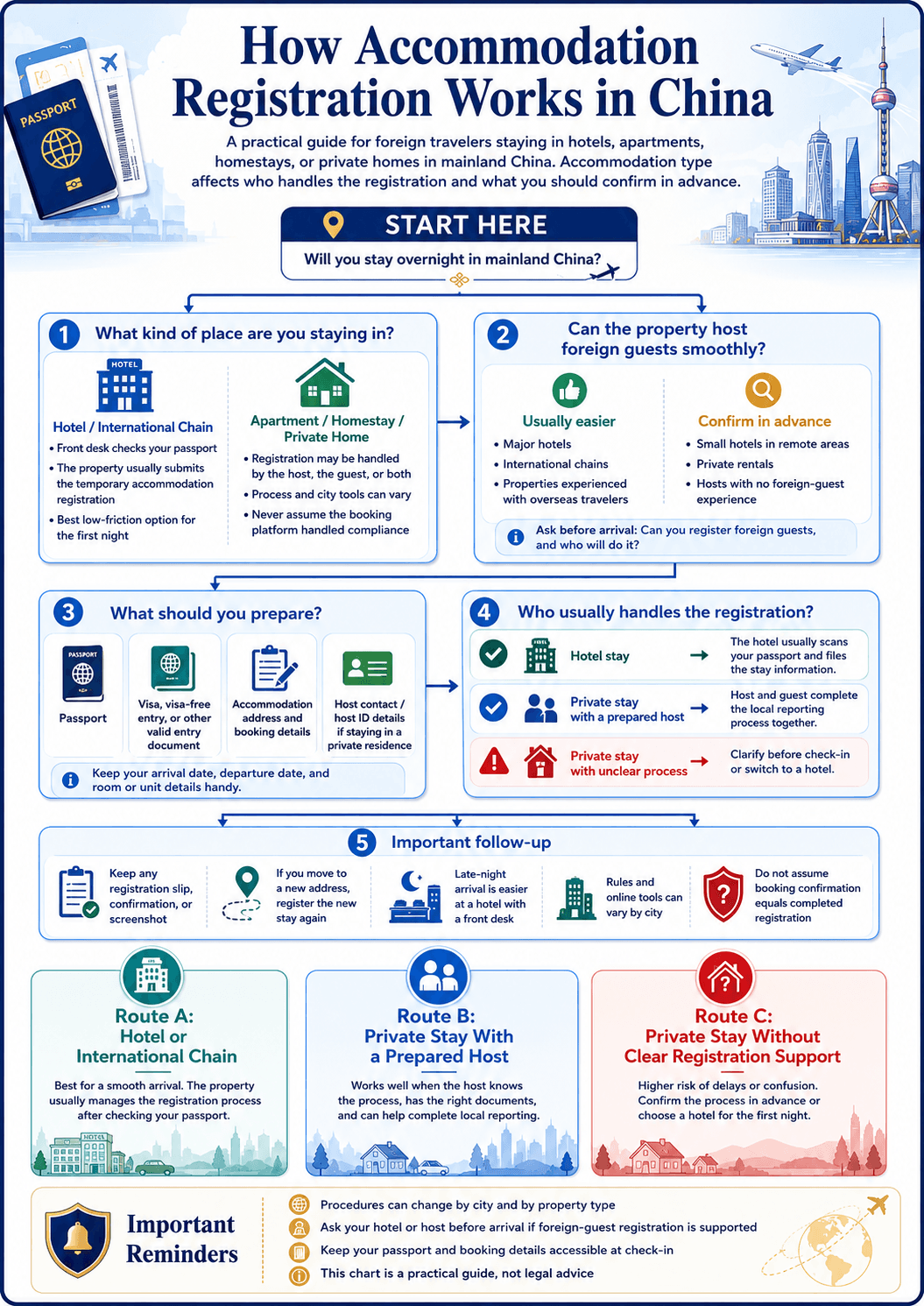
The visual shows the key split travelers need to remember: hotels normally handle accommodation registration, while apartments, homestays, and private residences often require separate reporting by the host or guest.
Keep this answer with your trip
Saved in this browser.
Practical answer, not legal advice.
Payment, telecom, app, and platform rules can change. Always verify current requirements directly with the relevant official authority or service provider before acting.
Sources
Check your first-night setup
Review check-in details, your Chinese address, booking proof, and a backup stay.