
Internet
China eSIM vs roaming: which should I use?
Start with your carrier’s China roaming allowance, then compare travel eSIM costs. Check your exact phone, SMS needs and app access before buying.
Choose roaming if it already covers your trip; compare eSIM if it does not
Home roaming: start here if your carrier includes mainland China with enough data for your dates. Compare the full-trip charge and allowances before buying another plan. A physical SIM can roam too; eSIM describes the SIM format, not a guarantee of coverage.
Travel eSIM: compare this if you need a separate data allowance and your exact phone supports it. Mainland phone number: if a specific service requires one, check a local SIM option; a data-only plan will not supply it.
Keep the number used for bank or Alipay verification reachable separately. There is no universal cheapest option: the right choice depends on your carrier, device, dates and data use.
Home roaming: check the whole allowance
Ask your carrier whether mainland China is included, how daily charges are triggered, and what happens after the allowance. Check calls, incoming SMS, hotspot use and any spending cap separately.
A suitable plan can reduce setup work, but roaming does not mean every service is included. Save your carrier’s instructions and support details offline.
Travel eSIM: check your device before buying
Check your exact model number and purchase region against Apple’s eSIM compatibility guidance, or your Android manufacturer’s official support page. Regional variants can differ even when the marketed phone name is the same. Do not assume every newer phone accepts a travel eSIM.
For a different carrier’s eSIM, confirm the phone is unlocked. On iPhone, check Settings → General → About → Carrier Lock; Apple’s travel instructions explain the status. Ask your carrier if it is locked.
Before paying, check mainland coverage, validity, when the plan starts, data limits, hotspot support and top-ups. Install with a stable connection and save the provider’s setup instructions offline.
Check the phone setup you plan to use
Use the free phone check to review data, verification texts and offline backups. Confirm device compatibility with your manufacturer before buying.
Data-only does not replace your home number
A data-only travel eSIM gives internet access, not calls or SMS to your existing home number. Check whether the specific plan includes a number, calls or SMS; messaging apps using data are a different service.
On a compatible dual-SIM phone, you can keep the home line available for codes while selecting the travel line for data. Confirm that your home carrier supports receiving SMS in China and check its charges. Keeping both lines on can still incur roaming fees.
If you are setting up Alipay, see whether you need a China phone number. Buying more data does not fix an unreachable verification number.
App access depends on the exact plan
Nomad’s China guidance describes access to several foreign services through its international routing. That is a provider-specific claim, not a promise that every eSIM or roaming plan behaves the same way.
Ask the provider about the apps you rely on. Save hotel details and a local-map route before departure so one inaccessible account does not prevent your airport-to-hotel journey.
Compare total cost and test on arrival
Calculate the total for your dates, including activation, daily fees, extra data and keeping your home number reachable. Compare those totals instead of an advertised starting price.
After landing, check the chosen data line and provider-required settings, then open a map route. Follow support instructions before deleting an eSIM that does not connect. Use the free phone check below to review your data, SMS and offline backup plan; it does not test device compatibility or guarantee network access.
Open the illustrated guide
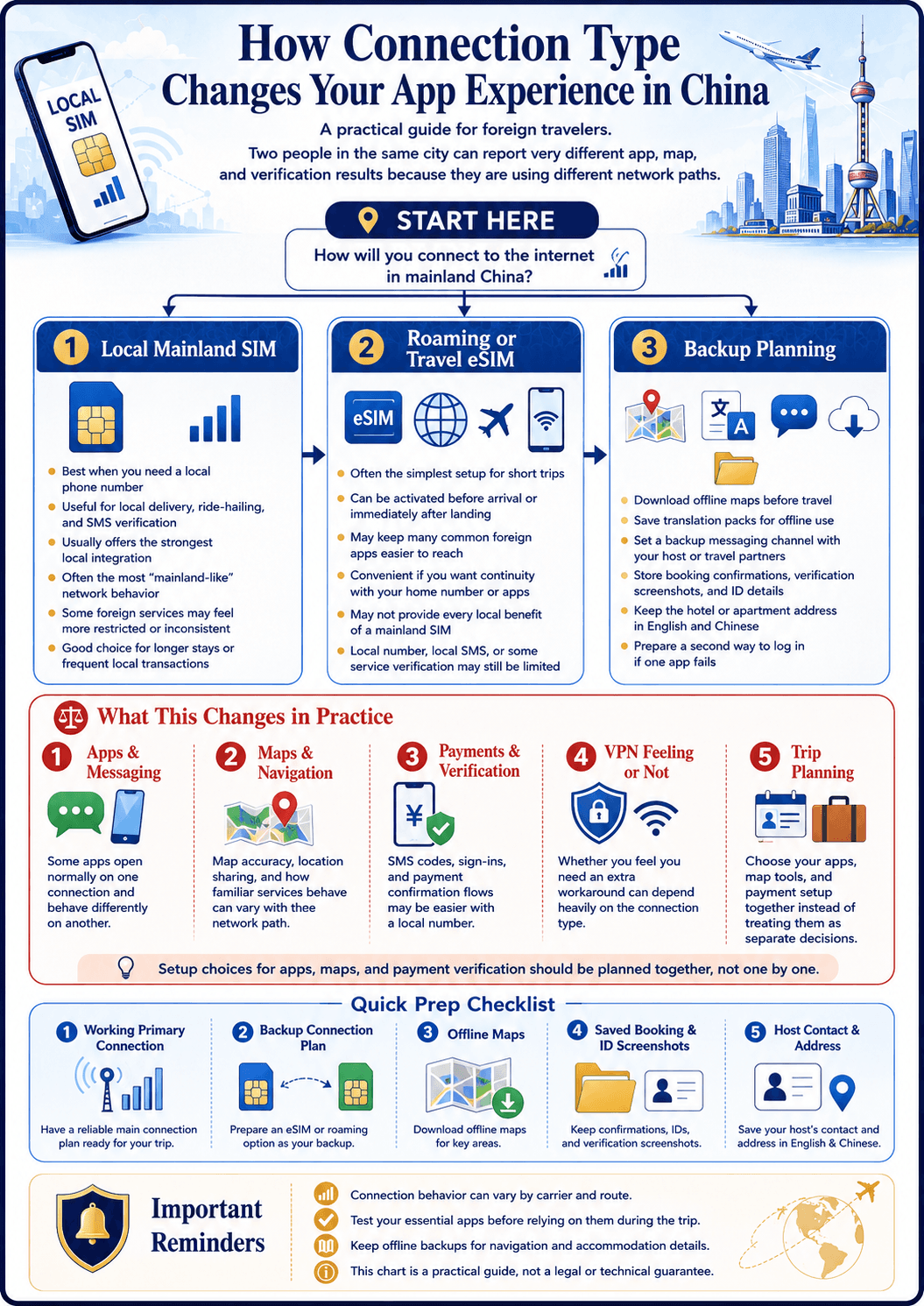
The comparison highlights the practical trade-off: travel eSIM and roaming are usually easier for access continuity, while local SIM is more useful when you truly need a mainland number or longer-term local service.
Keep this answer with your trip
Saved in this browser.
Practical answer, not legal advice.
Payment, telecom, app, and platform rules can change. Always verify current requirements directly with the relevant official authority or service provider before acting.
Sources
Check the phone setup you plan to use
Use the free phone check to review data, verification texts and offline backups. Confirm device compatibility with your manufacturer before buying.