
Internet
Do I need a VPN in China?
Maybe. Local mainland networks block many foreign services, while some roaming or travel eSIM routes keep them reachable without an extra VPN.
The useful framing
The first question is not really 'VPN or no VPN.' The first question is which network path you plan to use in China and which services are truly essential for your trip. Once you know those two things, the VPN decision becomes much easier and less emotional.
Travelers often overfocus on the tool name and underfocus on the connection environment. In practice, that is backwards. A separate VPN matters differently on a local mainland network than it does on a roaming or travel-eSIM setup that already keeps your traffic outside mainland routes.
When a separate VPN matters more
If you will rely on a local mainland connection and you know the trip depends on foreign services that are often unreliable there, then a separate VPN or comparable workaround becomes much more relevant. This is especially true for work travelers, long stays, and people whose daily communication or authentication chain sits on restricted services.
The risk is not only that you cannot open one familiar app. The larger risk is that your maps, messages, mail, file access, bank verification, or work login stack becomes brittle all at once.
When eSIM or roaming may reduce the problem
For many short-stay tourists, international roaming or a travel eSIM can already solve much of the access problem without adding a separate VPN app. This is one reason those options are so attractive for first-time visitors who want simplicity and continuity with their normal apps.
That does not mean every roaming or eSIM product behaves identically. It means the practical sequence should be: choose the connection type first, test what that connection already gives you, and then decide whether anything essential is still missing.
Build a resilient phone setup
Check your data, SMS recovery, offline cards, and phone backups before arrival.
Why this is still not a purely technical choice
Connectivity decisions in China sit inside a legal and policy environment that travelers should not treat casually. It is better to stay factual and conservative here: know that app availability can vary, know that official travel-advice pages acknowledge communication restrictions, and avoid building plans around assumptions you have not tested.
The practical goal for a traveler is not ideological purity. It is a stable communications setup that lets the trip function without last-minute improvisation.
What to do before arrival
Install and configure the tools you think you may need before entering mainland China. That includes maps, translation, tickets, payment apps, and any connection tools you plan to rely on. Do not assume app-store access, SMS verification, or account recovery will be equally easy once the trip is underway.
Also agree on a backup communications plan with family or work. A single pre-arranged channel that everyone knows how to reach is better than discovering in the moment that your usual stack has gaps.
What travelers still get wrong
The most common mistake is treating VPN as the only interesting decision. In reality, the bigger choice is often whether to use a local SIM, roaming, or a travel eSIM, because that changes the rest of the picture.
The second mistake is not testing. Whatever setup you choose, prove it early with the apps you actually need instead of assuming that a successful install means the system is ready.
Open the illustrated guide
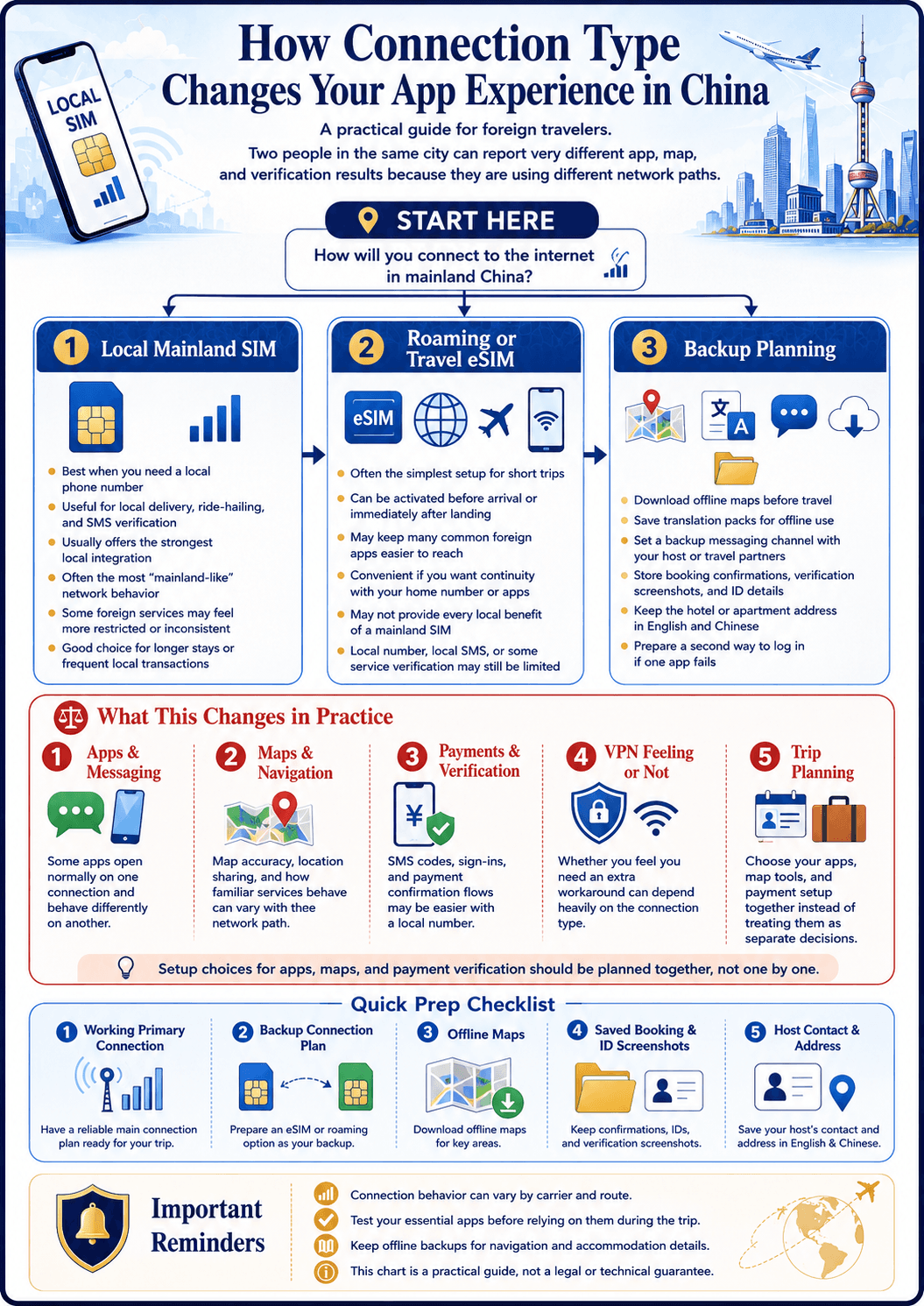
This visual is designed to stop the usual oversimplification. In practice the first question is not 'VPN or no VPN' but which network path you will use and which services your trip absolutely depends on.
Keep this answer with your trip
Saved in this browser.
Practical answer, not legal advice.
Payment, telecom, app, and platform rules can change. Always verify current requirements directly with the relevant official authority or service provider before acting.
Sources
Build a resilient phone setup
Check your data, SMS recovery, offline cards, and phone backups before arrival.