
Internet
What apps are blocked in China?
Many Google, Meta, and other foreign services are unreliable on mainland networks; actual access depends on SIM, Wi-Fi, roaming, or eSIM routing.
Think in categories, not only in app names
When travelers ask which apps are blocked, they usually mean several different categories at once: Google services, Meta messaging and social apps, foreign news and cloud tools, map products, and work tools that depend on those ecosystems. Each category matters differently depending on the trip.
That means a giant memorized list is less useful than understanding your own dependency stack. If the trip depends on Google Maps, WhatsApp, Gmail, Instagram, cloud drives, and two-factor codes delivered through blocked services, then the risk is operational, not theoretical.
Why network path changes the answer
A local mainland connection often behaves differently from international roaming or a travel eSIM route that keeps traffic outside the mainland path. That is why two travelers staying in the same hotel can report opposite experiences about whether a given app 'works in China.'
Once you understand that difference, a lot of online contradiction stops looking mysterious. The app question is often really a connection-path question in disguise.
What matters most in practice
The apps that matter most for travel survival are not always the ones people worry about first. Maps, messaging, payments, ride-hailing, translation, and account recovery tools usually matter more on the ground than social feeds or entertainment apps.
That is why most experienced travelers prepare substitutes before departure. Local map apps, offline translation, an agreed backup messaging channel, and wallet apps matter far more than collecting a dramatic list of everything that may be restricted.
Build a resilient phone setup
Check your data, SMS recovery, offline cards, and phone backups before arrival.
Account recovery is the hidden failure mode
A blocked or unreliable app is annoying. A blocked or unreliable recovery chain is much worse. If your bank alerts, email verification, password resets, or work logins all depend on services that become hard to reach, you can lose time on much more important problems than social media access.
This is why the best pre-trip preparation is boring but effective: offline copies, backup email access, backup authentication methods, and pre-arranged communications with family or work.
How to prepare without overcomplicating the trip
Choose your connection plan first, then decide whether you also need a VPN or some other workaround. Install local essentials before departure and download what you can for offline use. Do not wait until you are inside mainland China to start discovering which tools your day actually depends on.
If you are traveling in a group, align on communication before arrival. A single reliable shared channel is worth more than each person independently assuming their usual apps will behave normally.
What travelers still get wrong
The biggest mistake is asking for one static master list and then treating that as the whole problem. The more useful preparation is to map your essential tasks and make sure each one still has a working tool behind it.
The second mistake is ignoring connection type. Most conflicting traveler reports make sense once you ask whether they were on local data, hotel Wi-Fi, roaming, or a travel eSIM.
Open the illustrated guide
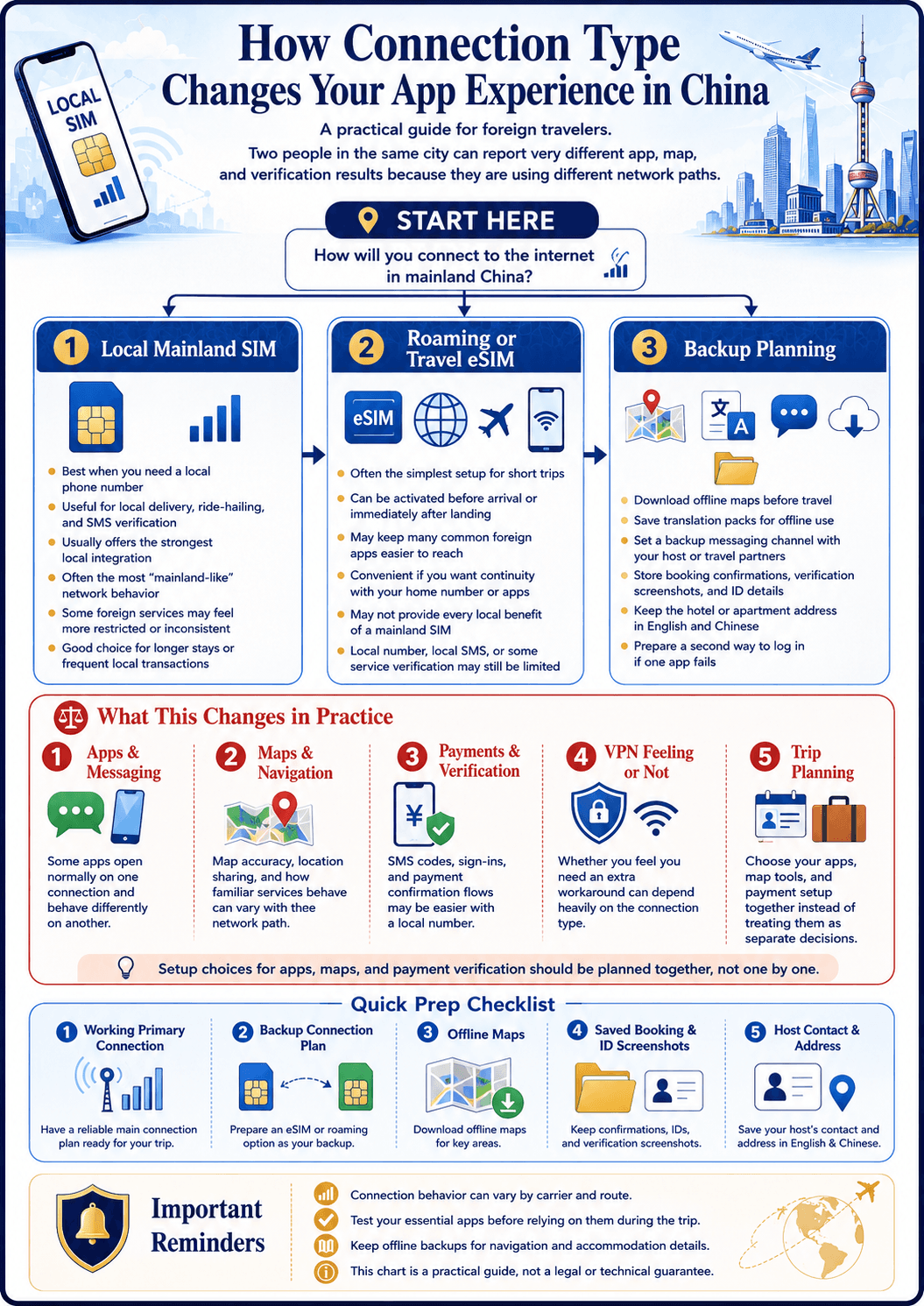
Blocked-app discussions are usually incomplete because they ignore network path. The image shows how local mainland networks, roaming, and travel eSIM routes can produce different app results in the same city.
Keep this answer with your trip
Saved in this browser.
Practical answer, not legal advice.
Payment, telecom, app, and platform rules can change. Always verify current requirements directly with the relevant official authority or service provider before acting.
Sources
Build a resilient phone setup
Check your data, SMS recovery, offline cards, and phone backups before arrival.