
Payments
Can I use credit cards in China?
Yes at hotels, airports, and some large retailers, but QR wallets linked to a foreign card are more useful for everyday spending.
Short answer
Yes, foreign credit cards are usable in China, but the right expectation is selective usefulness rather than universal daily acceptance. They remain strongest in places already built for international guests, higher-value transactions, and more formal merchant systems.
That means a traveler can absolutely benefit from bringing cards while still finding them weak as a stand-alone plan for ordinary neighborhood purchases. The distinction between 'cards work in China' and 'cards work everywhere the way they do at home' is the part that matters.
Where physical cards work best
Hotels, airports, upscale retail, major tourist venues, and some chain businesses are still the most dependable environments for direct foreign-card acceptance. These are the places where front-desk or point-of-sale systems are more likely to support international card flows cleanly.
That makes physical cards important for room charges, deposits, and bigger purchases even if you rarely tap or swipe them for day-to-day small spending once the trip starts.
Why wallet-linked cards are often more useful
In many ordinary merchant situations, the merchant is organized around QR-code payment rather than around card terminals for foreign visitors. Linking the card to Alipay or WeChat Pay often lets you use the merchant's preferred checkout pattern while still funding the purchase from your international card.
This is why asking only whether your Visa or Mastercard works misses the practical question. The more useful question is how your card can participate in the payment ecosystem China uses most naturally.
Test your payment readiness
Check your wallets, cards, cash, data, and first-day payment backups.
Where friction still appears
Small shops, market-style merchants, and highly local businesses may not be designed around direct foreign-card use at all. Even if the transaction is technically possible somewhere in theory, the real-world flow may be slow, uncertain, or simply not worth betting the trip on.
You should also assume that card-network acceptance and wallet behavior can diverge. A card that works perfectly at a hotel terminal may still hit friction when used through a wallet for a specific merchant or a specific in-app flow.
How to prepare the card before you travel
Bring at least two cards from different issuers or networks if possible. That protects you against fraud blocks, magnetic or chip issues, or a payment stack that happens to favor one network over another in your particular set of transactions.
It also helps to confirm online banking access, app-based approval methods, and emergency contact options before departure. The hardest part of a card problem abroad is often not the decline itself but the recovery process if the account verification chain depends on a service you cannot reach easily.
What travelers still get wrong
Many visitors still plan as if a physical international card can replace wallet preparation. In modern China that is usually backward. The card is essential, but often most useful when it sits behind a wallet rather than in front of it.
The other mistake is traveling with only one card. If that one card becomes your only point of failure, a simple bank review can become a much larger travel problem.
Open the illustrated guide
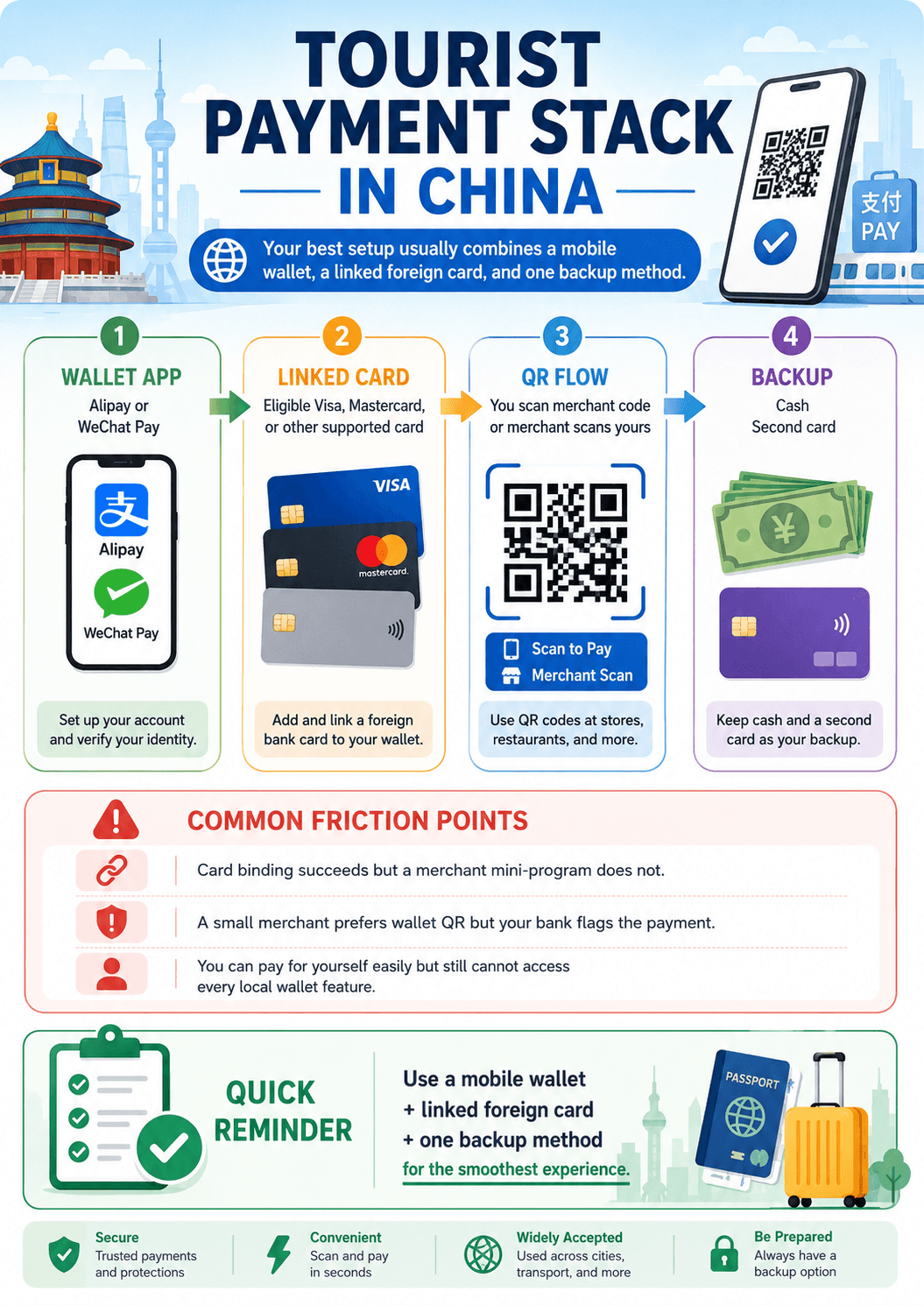
Foreign cards are strongest in international-facing venues and weaker at ordinary local merchants. The diagram compares direct card presentation with card-to-wallet use, which is often the more useful path.
Keep this answer with your trip
Saved in this browser.
Practical answer, not legal advice.
Payment, telecom, app, and platform rules can change. Always verify current requirements directly with the relevant official authority or service provider before acting.
Sources
Test your payment readiness
Check your wallets, cards, cash, data, and first-day payment backups.