
Payments
Is cash still accepted in China?
Yes. Cash is legal tender and useful as a backup, but it is not the smoothest main payment method for many everyday transactions.
Short answer
Yes, cash still matters in China and travelers should absolutely keep some renminbi available. The mistake is not carrying cash. The mistake is assuming cash remains the easiest everyday payment method in a country where ordinary merchant habits now lean heavily toward QR-code wallets.
That is why the right travel posture is balanced. Use mobile payment or other convenient methods when they work well, and let cash handle the failed wallet moment, the small edge case, or the place where your digital setup is weaker than expected.
Where cash still helps most
Cash is useful when you need immediate resilience: a wallet app fails, a battery dies, a foreign card is blocked, or a smaller merchant has trouble processing your setup. It can also help at some counters, taxis, or transport-adjacent situations where you simply need the transaction to end quickly.
It is especially valuable in the first day or two of a trip, before you have proven that your preferred digital payment stack is stable. A small amount of local currency gives you room to troubleshoot without turning every meal or taxi ride into a test case.
How much to carry and in what form
Carry cash in smaller notes, not only larger ones. Even when merchants accept cash, change-handling can be less convenient than it used to be, so smaller denominations make ordinary purchases easier and reduce awkward delay at the register.
There is no universal perfect amount because trip style varies, but the goal is modest resilience rather than an oversized emergency hoard. Enough for transport, food, and one or two fallback situations is more useful than a thick bundle you are reluctant to spend.
Test your payment readiness
Check your wallets, cards, cash, data, and first-day payment backups.
What cash does not solve well
Cash does not solve the app-centric parts of modern travel in China. It cannot stand in for all the services tied to ride-hailing, ticketing, delivery, or in-app ordering flows that expect a phone-based payment environment. Even when a merchant takes notes and coins, the broader service flow may still assume app use.
That is why travelers who rely only on cash often find themselves legally able to pay but operationally less efficient. You may still complete the purchase, but the travel experience is slower and more fragile than it needs to be.
How cash fits into a stronger payment stack
Cash works best as the bottom layer under a mobile wallet and at least one card backup. That structure gives you flexibility across the widest range of scenarios: app-first merchants, card-friendly hotels, and unexpected low-tech moments.
If you are traveling with family or friends, do not let one person carry the only usable cash. Spread small reserves across the group so one lost wallet or one separated traveler does not create a needless problem.
What travelers still get wrong
Some travelers now overreact in both directions. One group assumes cash is obsolete and arrives with none. Another group hears that cash remains legal tender and concludes it can replace digital preparation. Both approaches are weaker than they need to be.
The practical answer is simpler: bring some cash, but build the trip around the payment methods China now uses most naturally.
Open the illustrated guide
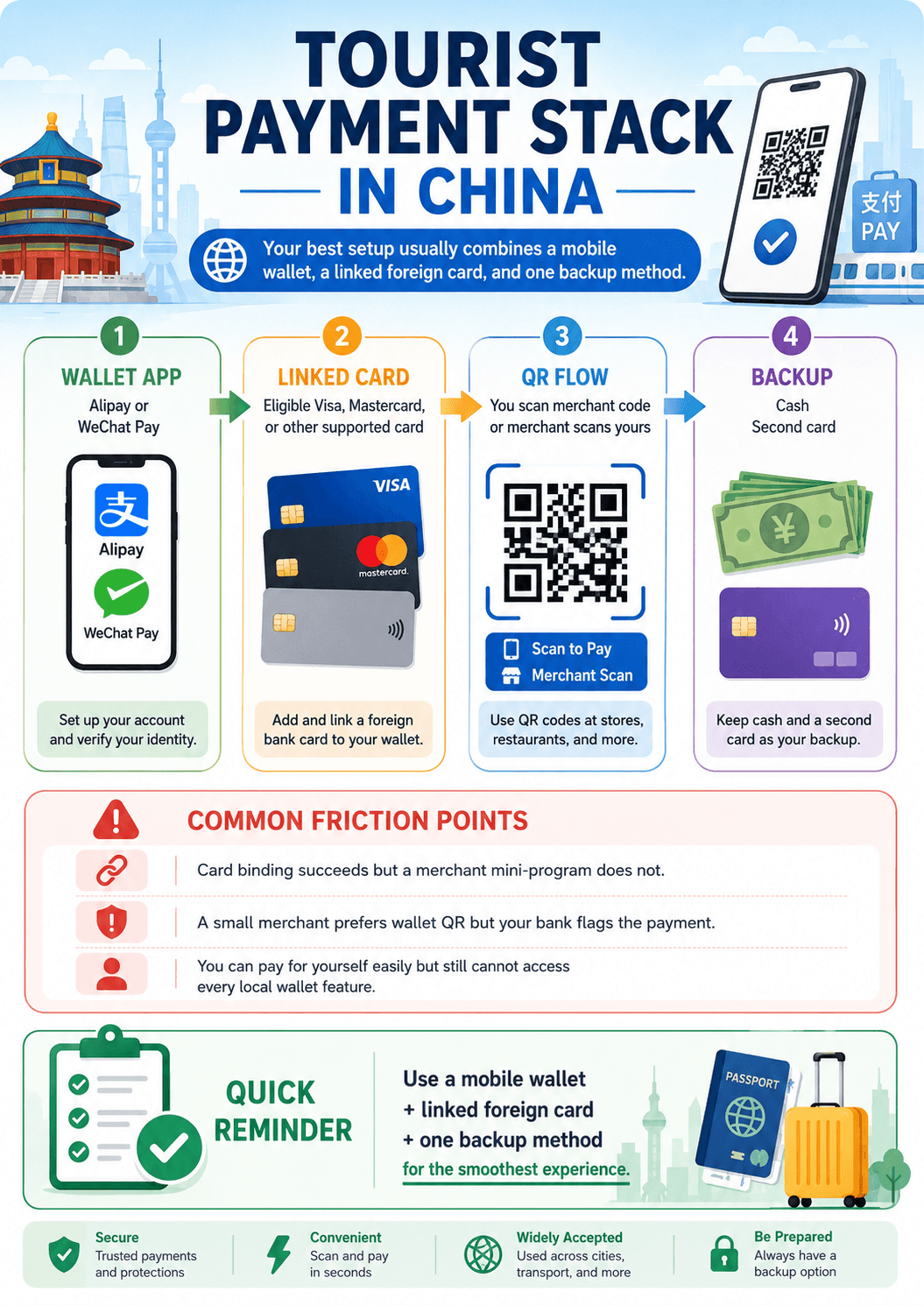
Cash still matters, but mainly as a fallback layer beneath wallets and cards. The visual shows where notes and coins help most: transport counters, small-value edge cases, and failed wallet moments.
Keep this answer with your trip
Saved in this browser.
Practical answer, not legal advice.
Payment, telecom, app, and platform rules can change. Always verify current requirements directly with the relevant official authority or service provider before acting.
Sources
Test your payment readiness
Check your wallets, cards, cash, data, and first-day payment backups.