
Internet
Does Google Maps work in China?
Prepare a second map for mainland China. Try Amap’s multilingual service, save Chinese addresses, and check your exact airport, station and hotel.
Prepare another map before you travel
Do not make your arrival depend on a single app or connection. Access to Google services can depend on the network route. Even an app that opens must still locate the correct destination and entrance.
Our practical recommendation is to prepare Amap alongside your usual map. Test the airport-to-hotel journey instead of installing an app without opening it.
Amap now has multilingual visitor services
Shanghai’s July 2026 guide describes Amap services in English and several other languages, including routes, saved hotel details and bilingual phrase cards. This gives visitors another navigation option.
Install the current app and inspect its language options on your device. Search your hotel in English, then compare the result with the Chinese name and address supplied by the hotel.
Save three places before departure
Save your arrival airport and terminal, first hotel, and exact station or airport for the next departure. Add Chinese names, street addresses and screenshots to your phone notes.
Check that the pin and booking refer to the same branch. A chain hotel or station name may match several places; the address and terminal are the useful checks.
Build a resilient phone setup
Check your data, SMS recovery, offline cards, and phone backups before arrival.
Check the final entrance and pickup point
At large venues, inspect the exit, pickup area and walking segment. A pin on the far side of a road or complex may not be the door you need.
For DiDi, follow the pickup location in the ride app. If you cannot find it, ask staff before booking. The area a map labels arrivals may not permit vehicle pickup.
Keep an offline handoff ready
An address and screenshot can help a driver or staff member when navigation fails. These are not live directions, so keep your hotel’s number and ask for help if the route is unclear.
Test what remains available with mobile data off. Offline search and downloadable areas differ by app and region; do not assume your usual workflow covers China.
If Google Maps opens, still check the journey
Nomad describes Google access for its China product. This neither establishes a rule for other providers nor confirms the accuracy of a particular map listing.
When timing matters, check current transport information and the venue’s own address. Save the free Shanghai arrival card for the first day and allow time for delays.
Open the illustrated guide
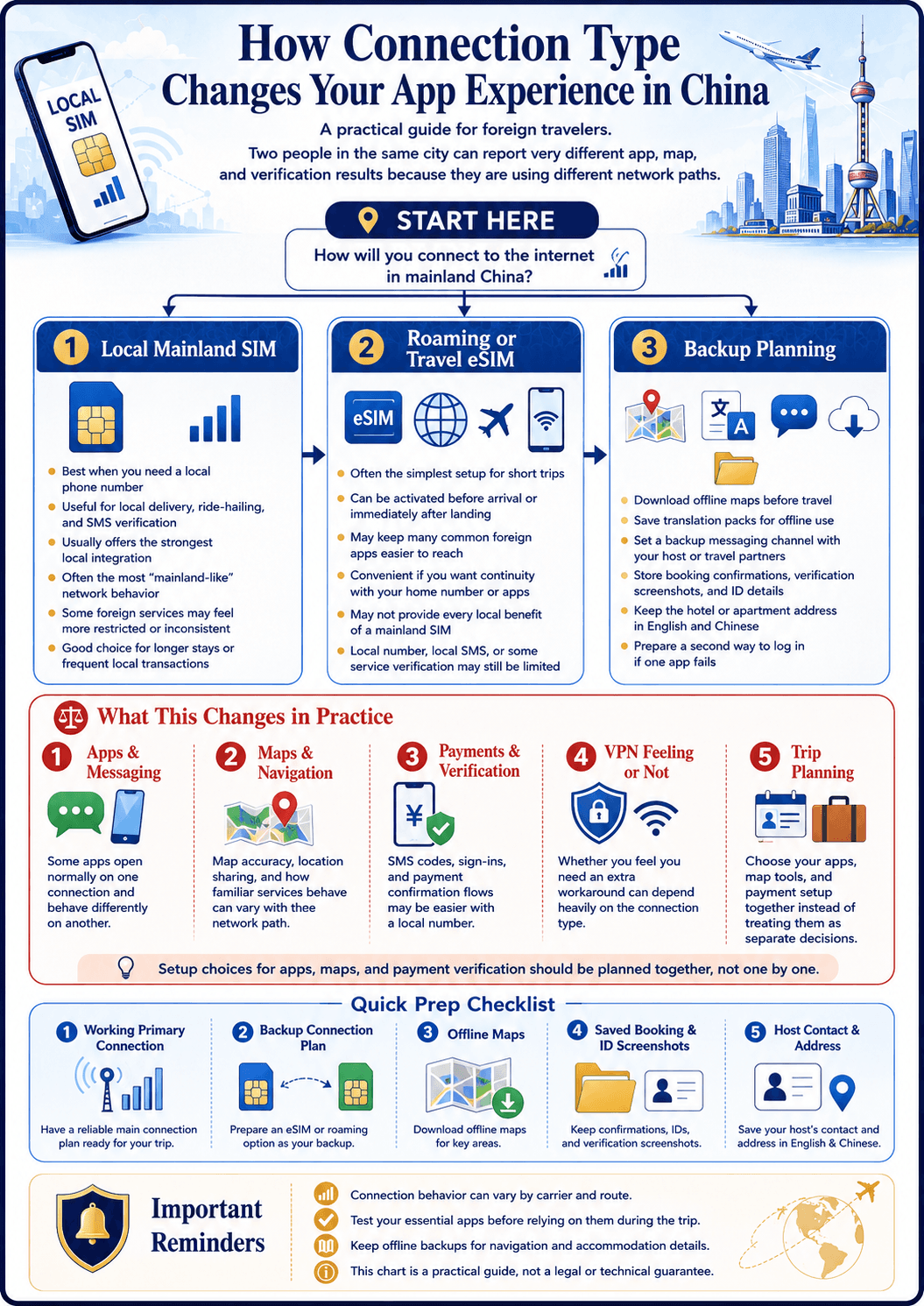
The visual compares Google Maps as a reference layer with local map apps as the execution layer for walking, public transit, and ride-hailing pickups. That is the workflow most visitors find reliable on the ground.
Keep this answer with your trip
Saved in this browser.
Practical answer, not legal advice.
Payment, telecom, app, and platform rules can change. Always verify current requirements directly with the relevant official authority or service provider before acting.
Sources
Build a resilient phone setup
Check your data, SMS recovery, offline cards, and phone backups before arrival.