
Visa & Entry
Need third-country ticket for China TWOV?
Yes. For 240-hour transit without visa, you need confirmed onward travel to a third country or region, not a simple return to your origin.
Short answer
Yes. The 240-hour transit program is built around onward travel to a third country or region. The NIA notice requires an onward arrangement with specified date and seat, and traveler reports consistently show that this is one of the first things airline staff and border officers look for.
If you cannot clearly show where you are going after mainland China, do not expect the transit-without-visa route to save you at the counter.
What counts as a third country or region
The destination after mainland China must be different from the place you came from. Hong Kong, Macao, and Taiwan count as separate regions for the policy, so many otherwise awkward itineraries work when the post-China segment is to one of those places.
What does not work is trying to dress up a round trip as transit. If your route is country A -> mainland China -> country A, that is not the transit structure the policy is written for.
How the ticket requirement works in practice
The safest version is a confirmed onward flight, ferry, or train booking that clearly shows the date, route, and passenger details, with the departure still inside the 240-hour window. Separate tickets can work, but they create more room for airline pushback if the desk agent thinks your evidence is weak or disconnected.
This matters because the first gatekeeper is often the airline, not Chinese immigration. Carriers are liable when they board passengers who do not meet document rules, so they tend to prefer simple and obvious proof.
Check your entry path
Turn this answer into a source-checked entry route before you book.
What can disqualify you
An unconfirmed standby plan, an onward route to the same country you originated from, or an onward segment that leaves after the allowed time window can all undermine the transit claim. So can a domestic ticket inside China that is not tied to a real exit to a third country or region.
If your route relies on a complicated explanation involving multiple PNRs, long self-transfers, or airport changes, assume you need more documentation than a straightforward through-booking would.
What to prepare before booking
Keep the onward ticket confirmation, passport used for the booking, and the official NIA notice together in one offline folder. Also save hotel details and any arrival-card information because officers may ask you to show the full transit plan, not only the outbound segment.
If you are using Hong Kong, Macao, or Taiwan as the third region, make sure the ticket itself makes that obvious. Travelers lose time when the itinerary looks ambiguous on a phone screen or in a foreign-language app.
What travelers still get wrong
Many people focus on whether Hong Kong or a layover 'counts' and forget the more practical issue: whether the ticket is confirmed, dated, and easy for an airline desk to understand. Legal eligibility is only half the problem.
The other recurring mistake is assuming immigration will do the interpretation work for them. In reality, if the airline never boards you, the immigration rule becomes irrelevant.
Open the illustrated guide
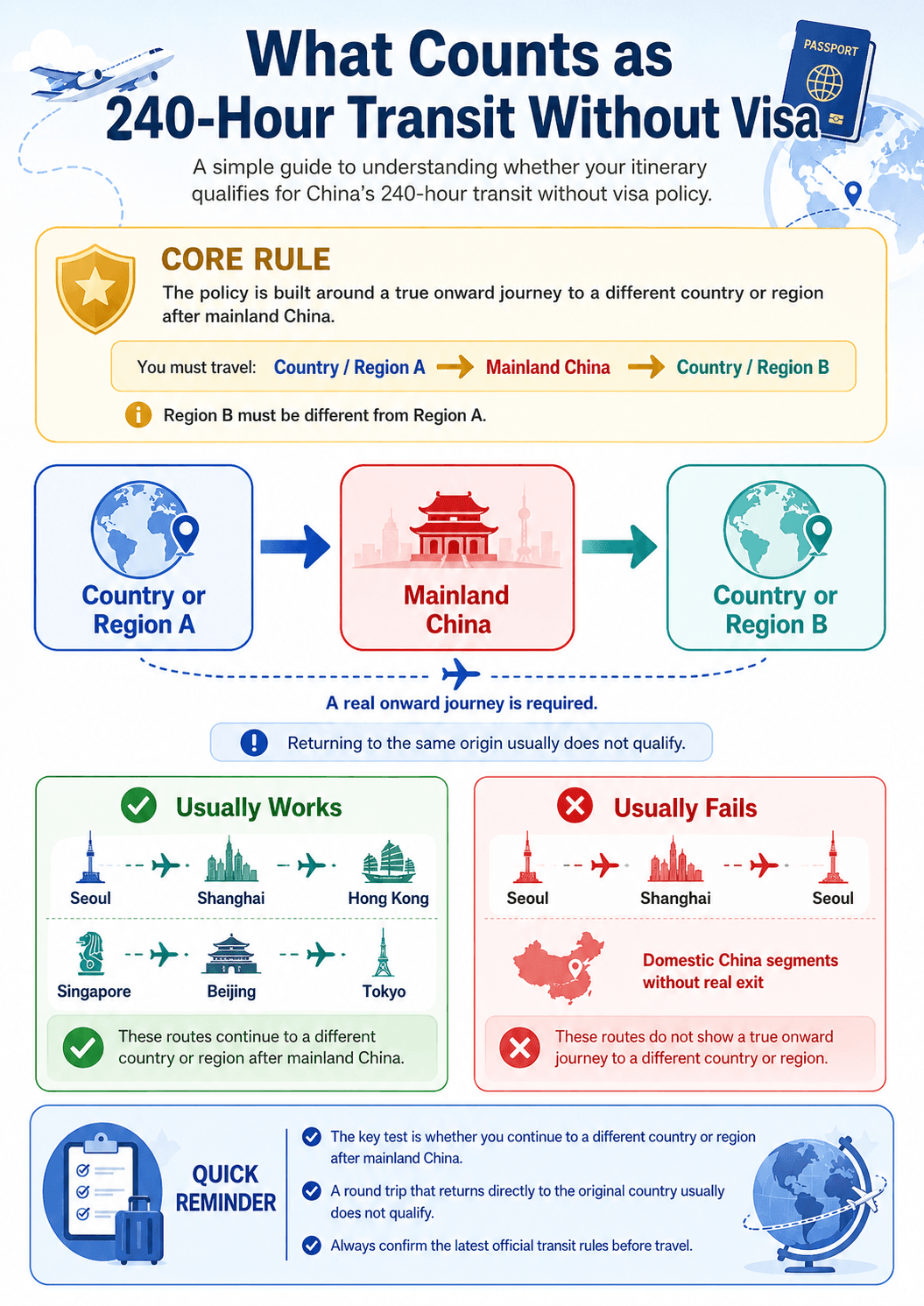
This visual shows the core transit pattern airline staff expect to see: country or region A, then mainland China, then a different country or region B. A simple out-and-back itinerary is the wrong shape for this policy.
Keep this answer with your trip
Saved in this browser.
Practical answer, not legal advice.
Payment, telecom, app, and platform rules can change. Always verify current requirements directly with the relevant official authority or service provider before acting.
Sources
Check your entry path
Turn this answer into a source-checked entry route before you book.