
Visa & Entry
Do I qualify for China 240-hour TWOV?
You need eligible nationality, a valid document, participating port, confirmed onward ticket to a third country or region, and a permitted stay area.
Short answer
NIA's August 20, 2026 policy covers 57 nationalities and 65 entry ports. You need an eligible ordinary passport, confirmed onward travel with a date and seat to a different country or region, and a stay within the published permitted areas for no more than 240 hours.
If any one of those pieces breaks, the whole transit plan can collapse. This is why 240-hour transit is not a good route for travelers who are guessing, changing plans on the fly, or relying on a check-in agent to interpret the rule generously.
Who this applies to
This route is for true transit travelers, not for anyone who simply wants a short China vacation without thinking about the onward segment. The NIA notice says travelers must be heading to a third country or region, which means the place after mainland China cannot be the same place they came from.
It also applies only through listed ports and only within the allowed stay areas. The policy became broader in 2025 and 2026, but it is still a geography-specific program rather than a free-form tourist entry.
How the rule actually works
Think of the structure as A -> mainland China -> B, where B is a different country or region from A. Hong Kong, Macao, and Taiwan are treated as separate regions for this purpose. A simple out-and-back to the same country does not qualify as transit without visa.
Cross-province visits are permitted within the designated areas in the current NIA table. Check each planned stop against that table; permission to enter through one port is not permission to visit any destination nationwide.
Check your entry path
Turn this answer into a source-checked entry route before you book.
What can disqualify you
The biggest disqualifiers are the wrong country pair, no confirmed seat out of China, the wrong entry port, or a passport that does not meet the document-validity rule. The NIA notice requires a valid international travel document and an interline or onward ticket with specified date and arrangements.
Another failure point is airline interpretation. Some travelers report that separate tickets or unusual routings create extra friction at boarding. Even when immigration would likely accept the plan, the airline may want cleaner evidence before letting you on the aircraft.
What to prepare before booking
Before paying, map the route exactly: arrival port, permitted stay area, onward destination, and departure within the 240-hour window. Then save the current NIA notice and your confirmed onward booking with seat assignment or equivalent ticket evidence.
Carry hotel bookings, local address details, and a copy of the third-country entry basis if that onward destination has its own visa rule. The Chinese transit rule does not solve your eligibility to enter the next place.
What travelers still get wrong
The most common misunderstanding is treating any stop in Hong Kong or any layover elsewhere as automatically good enough. The real test is whether your itinerary forms a genuine transit to a different country or region after mainland China and stays inside the policy geography.
Travelers also forget that this policy is operational, not theoretical. If your itinerary needs a five-minute legal explanation at the airport, you should assume it is too fragile and either simplify the route or get a proper visa.
Open the illustrated guide
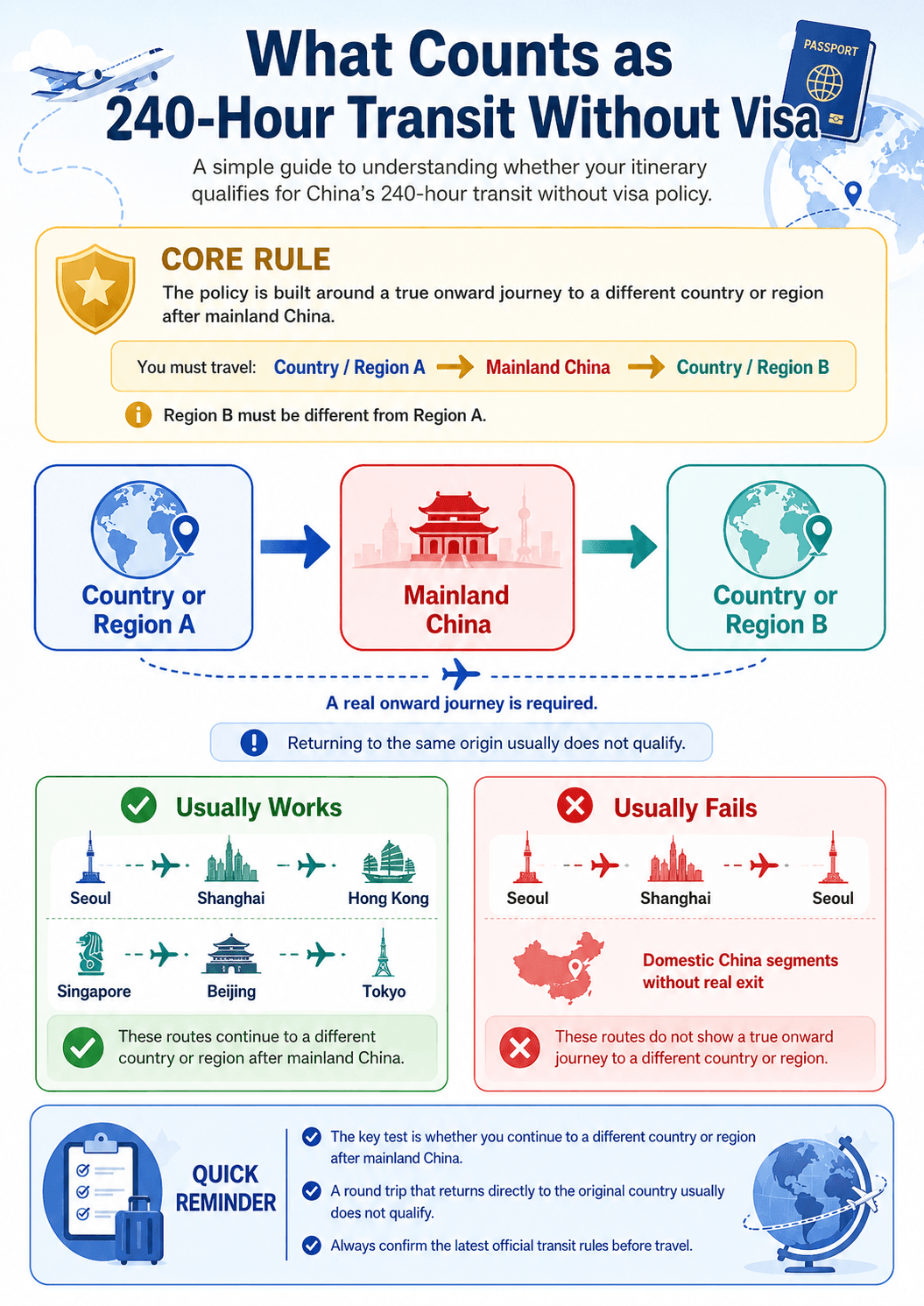
Transit without visa is a route rule, not a generic short-stay shortcut. The key branches are eligible nationality, participating port, onward travel to a third country or region, and staying inside the permitted area.
Keep this answer with your trip
Saved in this browser.
Practical answer, not legal advice.
Payment, telecom, app, and platform rules can change. Always verify current requirements directly with the relevant official authority or service provider before acting.
Sources
Check your entry path
Turn this answer into a source-checked entry route before you book.