
Visa & Entry
How long must my passport be valid for China?
It depends: regular visas often need six months and blank pages; 30-day visa-free needs validity for the stay; TWOV needs at least three months.
Short answer
There is no single passport-validity number that covers every China entry route. The clean answer is to match the validity rule to the route you will use: visa application, 30-day visa-free entry, or 240-hour transit without visa.
If you want the low-risk planning rule, aim for more than six months of passport validity and at least two blank pages whenever possible. That will satisfy the standard visa application threshold and reduce airline or check-in friction on other routes.
The three rules travelers mix up
For a regular visa application, current embassy guidance says the passport should have more than six months of remaining validity and at least two blank visa pages. That is the conservative benchmark most travelers already know.
For the 30-day visa waiver, the updated FAQ is narrower: an ordinary passport valid for at least the duration of intended stay is required. For 240-hour transit without visa, the NIA policy says the traveler must hold a valid international travel document with at least three months of remaining validity.
Why airlines and real life can feel stricter
Even when the visa-free route looks looser on paper, airlines may still be cautious if the passport is near expiry, the itinerary is complicated, or the agent is not familiar with the latest China rule change. This is especially true on transit-without-visa itineraries where the document logic is already more complex.
That is why many travelers treat six months as the practical planning floor even when the official route-specific wording is shorter. It is not always legally required, but it reduces arguments.
Check your entry path
Turn this answer into a source-checked entry route before you book.
What else to check besides the expiry date
Look at blank pages, passport type, and whether you still carry an old passport containing a valid China visa. A new passport plus an old valid visa can work in some cases, but only if the details line up cleanly and you bring both documents.
Also check whether your onward destination has its own passport-validity rule. China may accept your document under one route, while the place you are going next may not.
What to prepare before booking
Decide the entry route first, then measure the passport against that route's rule. Save the official page that supports your interpretation and keep it with your booking records. If your passport is close to the line, renewing before the trip is usually cheaper than testing how much discretion an airline desk will use.
If you are planning 240-hour transit, make sure the passport validity, onward ticket, and eligible port all work together. A passport that is technically fine for one part of the plan can still fail the total package.
What travelers still get wrong
The biggest mistake is copying the six-month visa-application rule into every other route without checking whether they are actually applying for a visa. The second biggest mistake is doing the opposite and assuming the visa-free FAQ makes any nearly expired passport safe for travel.
Use the route-specific rule, but plan conservatively when the trip is expensive. That is the balance that keeps both the law and the airport desk on your side.
Open the illustrated guide
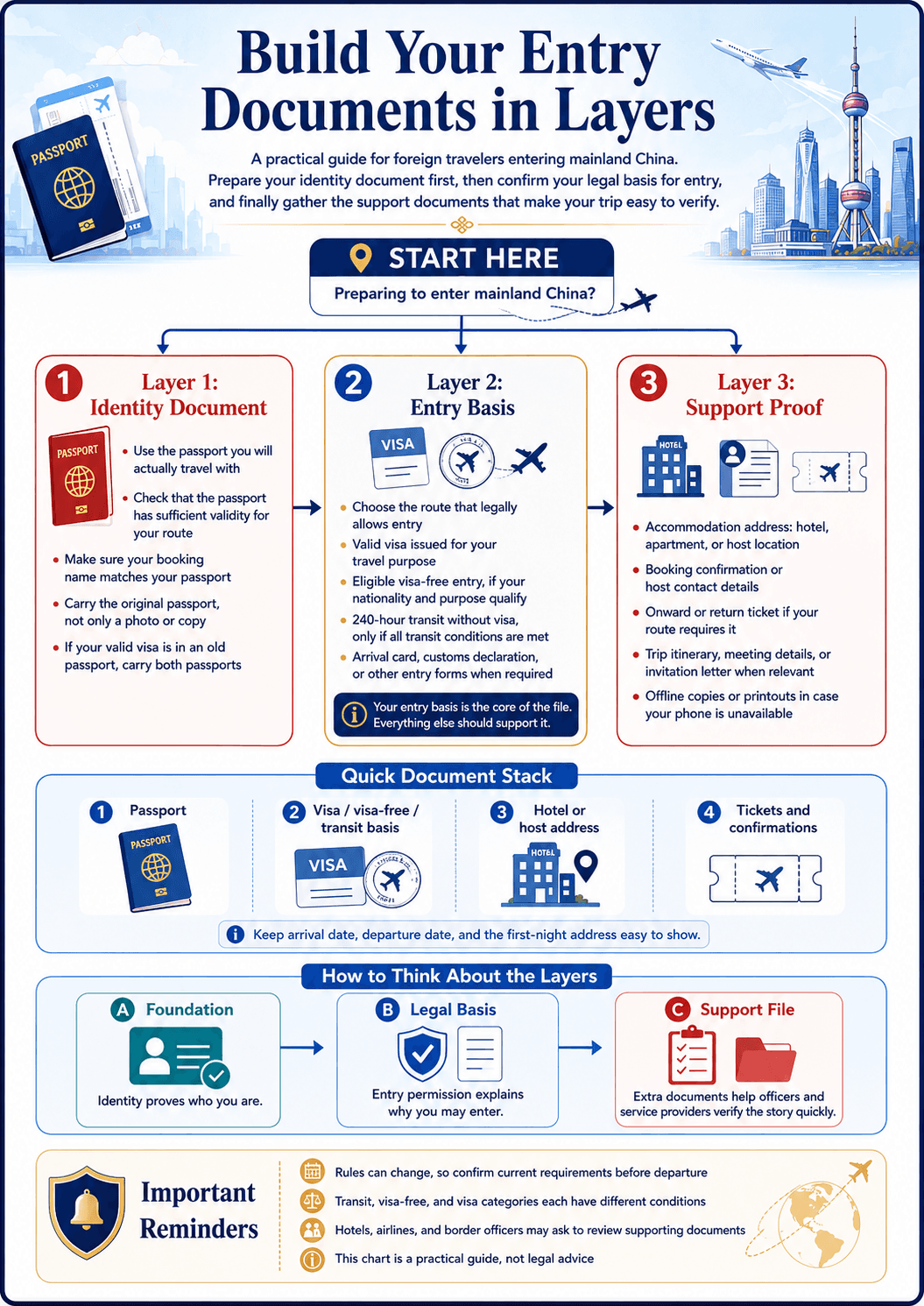
Passport validity is one of the most mixed-up topics because the required threshold depends on whether you are applying for a visa, entering visa-free, or using transit without visa. The diagram compares those routes at a glance.
Keep this answer with your trip
Saved in this browser.
Practical answer, not legal advice.
Payment, telecom, app, and platform rules can change. Always verify current requirements directly with the relevant official authority or service provider before acting.
Sources
Check your entry path
Turn this answer into a source-checked entry route before you book.