
Visa & Entry
Can my nationality enter China visa-free?
Maybe. China has several visa-free channels with different country lists, so check nationality, passport type, purpose, route, and stay length.
Short answer
Do not treat 'China is visa-free now' as a universal rule. China currently uses several different visa-free tracks, including unilateral 30-day visa-free entry for certain ordinary-passport nationalities, bilateral mutual visa-exemption arrangements, 24-hour direct transit, 240-hour transit without visa for eligible nationalities in true transit, and some regional policies.
That means your answer depends on the exact route you are using. A traveler who qualifies for 30-day visa-free entry can move differently from a traveler using 240-hour transit without visa, and both of them are different from a traveler who still needs a standard visa.
Who this applies to
Start with your passport, not your residence or where you bought the ticket. The embassy and National Immigration Administration pages are keyed to nationality and passport type, and ordinary passports are treated differently from temporary, emergency, or travel documents.
Also check purpose. The current visa-free FAQ says the 30-day visa waiver covers business, tourism, family or friends visits, exchange, and transit. It does not cover work, study, journalism, or other activities that sit outside that list.
How the rule actually works
The cleanest way to think about it is to sort yourself into one of three buckets. Bucket one: your ordinary passport nationality is on the current visa-free list and your trip purpose fits the allowed uses. Bucket two: you are not in that first list, but your itinerary may qualify for 240-hour transit without visa because you are genuinely passing from country or region A through mainland China to country or region B. Bucket three: neither of those applies and you should assume you need a visa.
The country lists also change. The State Council and embassy pages show that the unilateral visa-free list expanded again in 2025 and 2026, while transit-without-visa eligibility and entry ports were updated separately. Do not rely on an old blog post that names only the 2024 or 2025 list.
Check your entry path
Turn this answer into a source-checked entry route before you book.
What can disqualify you
Common disqualifiers are simple but costly: using the wrong passport type, traveling for work or study under a tourist-style plan, overstaying the 30-day limit, assuming a return to the same country qualifies as transit, or arriving with a passport that is valid for too short a period for the route you chose.
Airlines and border officers also look at whether your documents match the rule you want to use. If your story is 'tourism' but you cannot show accommodation, onward travel, or a plausible short-trip plan, you are inviting extra questions at boarding or arrival.
What to prepare before booking
Check three things in this order: the latest embassy eligibility page for your nationality, the NIA page for the route you plan to use, and the airline or transit conditions if you are trying to use transit without visa. Save screenshots or PDFs of the official page you relied on because airport staff may not know the newest expansion immediately.
Then prepare your passport details, hotel booking, invitation or business support documents if relevant, and any onward ticket evidence that the route requires. If you still cannot explain your exact entry basis in one sentence, treat the trip as visa-required until you can.
What travelers still get wrong
Travelers often mix up 'my nationality is on some China visa-free list' with 'my exact itinerary is approved under the rule I want'. Those are not the same question. Visa-free entry, transit without visa, and ordinary visa entry each have different timing, geography, and document logic.
The second recurring mistake is trusting a hotel, forum, or generic booking site more than the actual immigration rule. Use traveler reports to spot friction, especially airline check-in or small-airport confusion, but use official pages to decide whether you qualify.
Open the illustrated guide
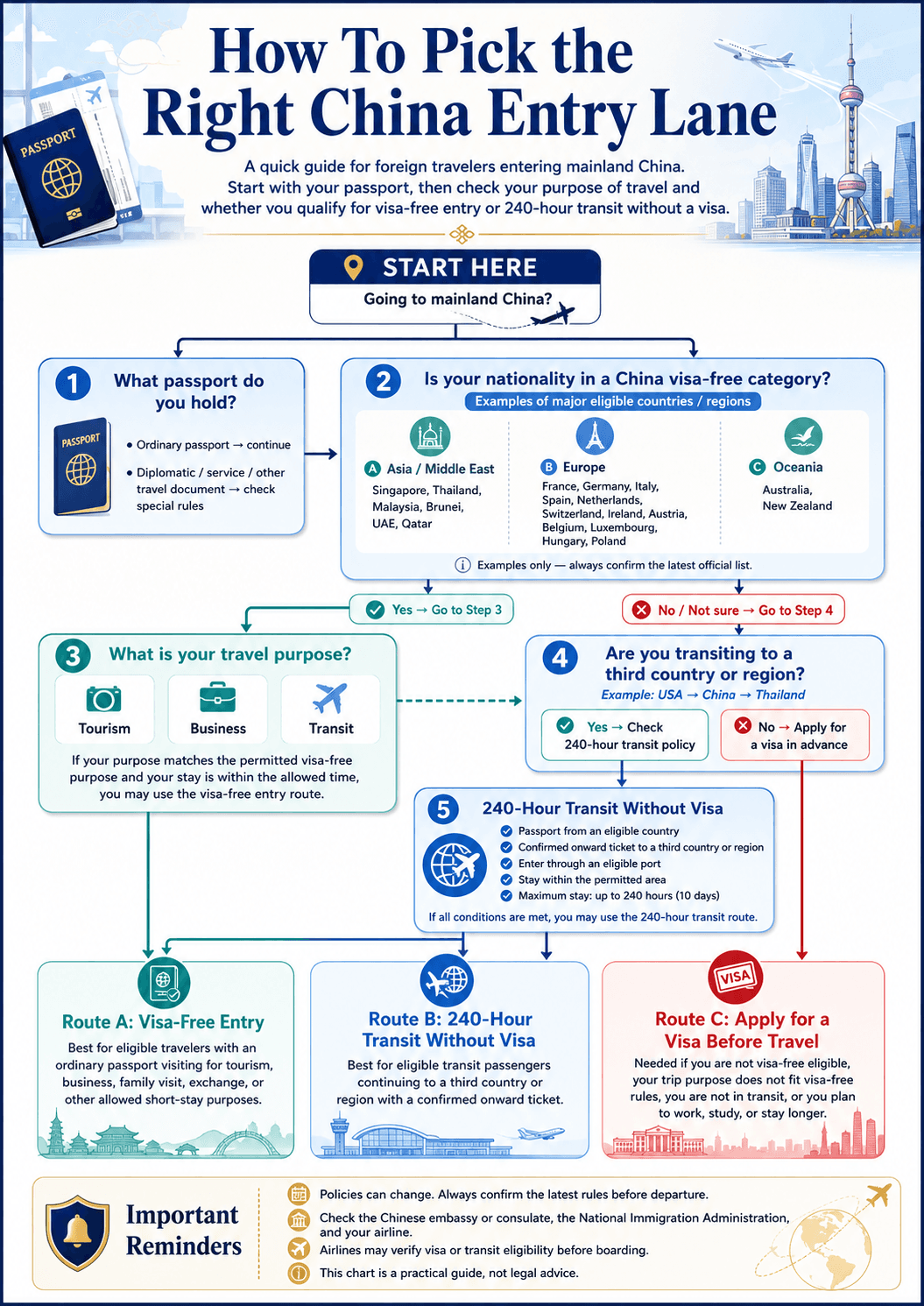
Use this diagram to separate nationality-based visa-free entry from transit without visa and ordinary visa travel. The first check is always passport nationality and travel purpose, not where you live.
Keep this answer with your trip
Saved in this browser.
Practical answer, not legal advice.
Payment, telecom, app, and platform rules can change. Always verify current requirements directly with the relevant official authority or service provider before acting.
Sources
Check your entry path
Turn this answer into a source-checked entry route before you book.